

Last updated: 09 September 2026
A founder transfers money from an Irish LTD to a personal account each month, intending to "sort it out" later. Unless each payment is salary, a properly declared dividend, a genuine expense reimbursement, repayment of money previously lent to the company, or a compliant loan, the company has created an overdrawn directors loan account. The withdrawal may breach company law and create a company tax charge alongside a personal benefit in kind exposure.
What is a directors loan account in an Irish company what you can and cannot take out?
A directors loan account is a running ledger of money moving between a director and the company. It isn't a second bank account. It records whether the company owes money to the director, or whether the director owes money to the company.
The account appears because owner-directors often pay company costs personally, inject funds during start-up, receive reimbursements, draw salary, receive dividends, or make payments from the company account before the correct accounting treatment is confirmed. A credit balance means the company owes the director. A debit or overdrawn balance means the director has received more from the company than the company has properly classified as salary, dividend, reimbursement or repayment.
That distinction matters because an Irish LTD is a separate legal person. Company cash belongs to the company, even where one person owns all the shares and controls the bank account. The Companies Act 2014 provisions on loans to directors treat personal borrowing as a regulated conflict-of-interest transaction, not as ordinary drawings.
Practical rule: Every transfer should have a classification before it leaves the company account, not a journal entry added at year end.
A properly maintained ledger also helps an international founder separate company funds from personal funds while the business is being established remotely.
The decision is straightforward. Salary belongs through payroll, dividends require distributable profits and proper company records, expenses need business evidence, and a loan requires company law analysis, written terms and tax review.
Why are the two directions of a directors loan account not treated alike in Ireland?
The account has two different directions.
| Account position | What it normally means | Main compliance question |
|---|---|---|
| Credit balance | The director has funded the company or paid company costs personally | Can the company repay an amount properly owed? |
| Debit balance | The director has received company money personally | Is the withdrawal salary, dividend, reimbursement or a lawful loan? |
When the account is in credit, the director is a creditor of the company. Repayment returns money that the director advanced or spent for the company. The payment still needs supporting records, but it isn't automatically a loan from the company to the director.
An overdrawn account is different. It shows that company money has moved towards the director without an established payment route. Section 239 of the Companies Act 2014 generally prohibits a company from making a loan or quasi-loan to a director, a connected person, or a person connected with that director. It also covers acting as creditor in a credit transaction and guaranteeing or securing borrowing arranged by a third party.
The connected person rule prevents a director from avoiding the restriction by routing money through a spouse or another company controlled by the director. The company must analyse the substance of the arrangement, not just the name on the receiving account.
A non-resident founder also needs to address director-residency requirements separately from loan-account treatment. An EEA-resident director, or a section 137 bond, answers the residency question, and neither of them changes how a withdrawal from the company account is classified.
What can you lawfully take out of an Irish company as a director?
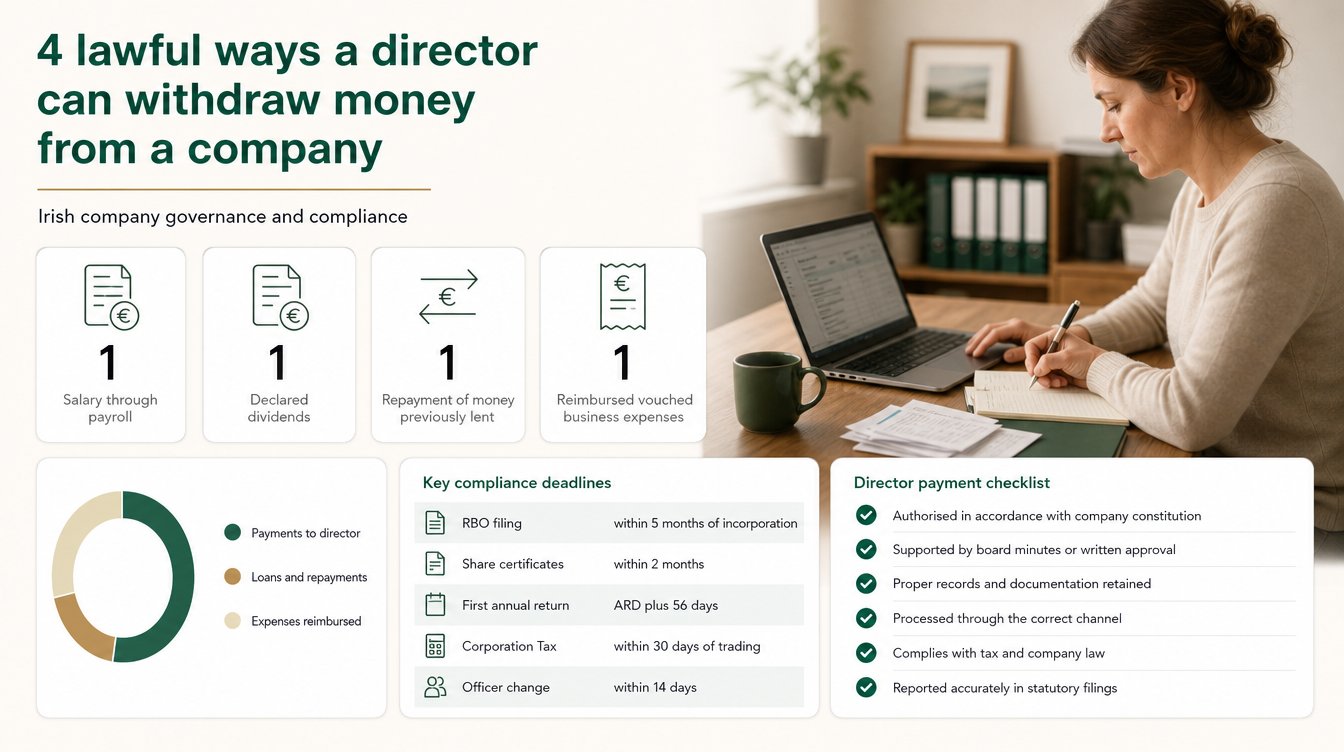
There are four ordinary routes. Each has a different condition, and none should be used as a label applied after a personal withdrawal.
Salary through payroll is the correct route for recurring remuneration for the director's work. The company should approve the remuneration, operate the relevant Irish payroll treatment and record the payment as remuneration. A monthly round sum used for living costs isn't an expense advance merely because the director calls it one.
A dividend is available only where the company has distributable profits and the payment is properly declared and documented. A transfer described as a dividend doesn't become one if the company has no distributable profits. The director's shareholder entitlement and the company's accounting records must support the payment.
Repayment of money previously lent to the company is a repayment of a genuine credit balance. The director should be able to show the original payment, its business purpose or funding purpose, and the amount still owed. A director can't create a repayment by describing an unexplained withdrawal as a refund.
Vouched business expenses can be reimbursed where the director incurred the cost for the company's business and retains appropriate evidence. An advance against a specific, expected business cost should be settled against receipts promptly. A general float that remains unsupported becomes difficult to distinguish from a loan.

The company structure should be set correctly from the outset, because the statutory records that support these four routes are created at formation, not after the first withdrawal. That groundwork is what Irish resident company formation puts in place.
Personal reporting must also be considered. Where the director has taxable income requiring a return, the relevant Irish income tax return filing service is the appropriate place to address the director's personal filing rather than forcing personal withdrawals through the loan account.
What can you not take out without breaching section 239 of the Companies Act 2014?
Section 239 establishes the default prohibition. An Irish company generally can't make a loan or quasi-loan to a director of the company or its holding company, or to a person connected with such a director. The company also can't act as creditor in a credit transaction for that person, or guarantee or secure a third party transaction for that person.
A lawful loan therefore needs a recognised route. The first is the narrow value exception in section 240. Section 239 doesn't prohibit an arrangement where its value, taken together with the amount outstanding under other arrangements with any director or connected person, is less than 10 per cent of the company's relevant assets.
The second route is the Summary Approval Procedure. Section 242 permits the arrangement above that limit only where the procedure is followed. Section 200(1)(e) identifies section 239 as a restricted activity, and the procedure must be read with section 202. The required declarations and member approval must be completed before drawdown. Retrospective paperwork doesn't turn an earlier prohibited withdrawal into a compliant one.
Several recurring transactions fail this test:
- Personal card spending: A company card purchase for private items remains personal spending. Journalling it to the loan account later doesn't make the original withdrawal lawful.
- Connected-person transfers: A payment to a spouse or controlled company is still caught where the recipient is connected with the director.
- Asset transactions: Section 238 requires general-meeting approval where the company acquires a non-cash asset from a director, or a director acquires one from the company, and the asset is of the requisite value. Section 238(2) sets that test: the value must be not less than EUR 5,000 and, subject to that, must exceed either EUR 65,000 or 10 per cent of the company's relevant assets.
- Invalid dividends: Calling a withdrawal a dividend where there are no distributable profits doesn't cure the transaction. It isn't a dividend merely because the bookkeeping entry says so.

How do you apply the 10 per cent relevant assets test in practice?
Section 238(2) defines relevant assets by reference to the value of the company's net assets shown by the last entity financial statements prepared under section 290 and laid under section 341. If no such financial statements have been laid, the relevant figure is the amount of called-up share capital.
The test aggregates the proposed arrangement with amounts outstanding under other arrangements involving any director or connected person, and section 240(2)(c) disregards any arrangement that was itself entered into under the Summary Approval Procedure. It isn't a separate allowance for each transfer, each director, or each receiving account.
Consider this plain example:
| Item | EUR |
|---|---|
| Net assets shown by the last accounts laid under section 341 | 100,000 |
| 10 per cent relevant-assets limit | 10,000 |
| Existing arrangements with directors and connected persons | 6,000 |
| Proposed additional loan | 3,000 |
| Total after proposed loan | 9,000 |
The total remains below the 10 per cent limit in this example. A further arrangement would need a fresh calculation because the relevant total has changed. If the proposed loan instead produced a combined total of EUR 10,000 or more, the wording of section 240, which requires the value to be less than 10 per cent, wouldn't provide the safe route. The company would need to consider the Summary Approval Procedure under section 242 before the money moved.
The test is a company-level calculation, not a personal allowance for the director.
The accounts used must be identified and retained. Directors should also monitor whether new arrangements, repayments or changes in the company's relevant assets alter the position. Clearing an overdrawn balance before the accounting records are finalised can reduce tax exposure, but it doesn't replace approval that was required before drawdown.
What paperwork proves a directors loan is compliant under sections 236 and 237?
Written terms protect both sides, but sections 236 and 237 apply differently depending on the direction of the loan.
Where the company lends to the director and the terms aren't in writing, or are ambiguous about repayment or interest, section 236 presumes, until the contrary is proved, that the loan is repayable on demand and bears interest. That presumption can make an undocumented balance more demanding than the director expected.
Where the director lends to the company, section 237 takes the opposite approach. Without written terms, the transaction is presumed not to be a loan at all. If a loan is proved, it is presumed to bear no interest, be unsecured and be subordinate to all other company indebtedness, unless the contrary is proved.
A short agreement should exist before the money moves. It should state:
- Principal: The amount advanced and the date of drawdown.
- Repayment: The repayment date, or that the amount is repayable on demand.
- Interest: The agreed interest treatment.
- Security: Any security or ranking agreed between the parties.
- Purpose: The commercial reason for the arrangement.
The board should minute its decision, post the entry in the same month, and retain bank evidence. The financial statements should disclose relevant loan arrangements. Where the amount exceeds the section 240 route, the directors' declaration and members' special resolution required for the Summary Approval Procedure should be completed before drawdown.
A company acquired as a ready-made structure still needs its own current records. A clean pre-trading history says nothing about later director transactions, which require their own documentation and accounting treatment.

What tax arises in Ireland when a directors loan account is overdrawn?
Company law permission doesn't remove the Irish tax charge. For a close company, section 438 TCA 1997 applies where the company makes a loan or advance to a participator or director. The company accounts for income tax at the standard rate on the grossed-up equivalent for the year of assessment in which the loan or advance is made. Revenue's own words are that the company must pay Income Tax at the standard rate on the grossed-up amount of the loan, and its published worked example on loans to participators takes a net loan of EUR 12,000, grosses it up to EUR 15,000 at 100/(100-20), and charges income tax of EUR 3,000. The company accounts for the charge through its corporation tax return. If the loan is later repaid, the company can reclaim the tax, but in Revenue's wording the claim must be made within four years of the end of the year of assessment in which the loan is repaid.
Section 439 deals with release or write-off. If the loan is released or written off, the borrower is treated as receiving income which, after deduction of income tax at the standard rate, equals the amount released. The related credit isn't repayable, so writing off the balance isn't a clean substitute for repayment.
A separate benefit in kind issue arises on preferential borrowing. The specified rates published by Revenue, set by the Department of Finance and current at 4 August 2026, are 4 per cent for a qualifying home loan and 13.5 per cent for all other loans, and they can change. The benefit reflects the preferential interest treatment and may create personal exposure even where the company loan is within a company law exception.
The name collision must be kept clear. Section 239 of the Companies Act 2014 is the company law prohibition. Section 239 of the Taxes Consolidation Act 1997 is the tax provision under which the company accounts for the relevant income tax. The tax charge doesn't come from the Companies Act.
A loan account shouldn't be used as a substitute for proper sale, remuneration or dividend planning.
What happens if you breach the rules and how do you stay compliant?
Section 246 of the Companies Act 2014 makes a transaction or arrangement breaching section 239 voidable at the instance of the company. Under section 247, where the company is being wound up and can't pay its debts, the court may declare the beneficiary personally liable, without limitation, for all or part of the company's debts if the arrangement materially contributed to that inability or substantially impeded the orderly winding up.
A practical compliance check should be completed before each withdrawal:
- Classify it: salary, dividend, expense, repayment or loan.
- Test it: aggregate director and connected-person arrangements against relevant assets.
- Document it: sign terms and approve the transaction before drawdown.
- Reconcile it: post each entry in the month it occurs.
- Escalate it: use the Summary Approval Procedure where the section 240 route isn't available.
- Correct it: repay unsupported balances and obtain tax advice promptly.
When the structure is being established, Irish resident company formation helps place the company, director and statutory records on the correct footing. How the company was acquired does not change the director loan rules.
Can a director take money from an Irish company whenever needed?
No. Company money belongs to the company, and each withdrawal must be treated as salary, a properly supported dividend, a genuine expense reimbursement, repayment of a credit balance, or a compliant loan arrangement. An unexplained personal transfer creates an overdrawn directors loan account and may produce company law and tax consequences.
Does the 10 per cent limit apply separately to each director?
No. The section 240 test aggregates the proposed arrangement with amounts outstanding under other arrangements involving any director of the company or any connected person. The company must calculate the combined position using the relevant-assets basis in section 238(2), rather than treating each director as having a separate threshold.
Can a company loan be repaid later and still be corrected?
Repayment can allow the company to reclaim the section 438 tax within the statutory period, but repayment doesn't erase a company law breach that occurred when the money was advanced. The original approval, written terms and timing remain important, particularly where the transaction required the Summary Approval Procedure before drawdown.
What should a director do when the account is already overdrawn?
The director should stop further personal withdrawals, reconcile the ledger to bank records, identify whether any entries are salary, dividends, expenses or genuine repayments, and obtain Irish tax and legal advice. Unsupported balances should be addressed promptly, with repayment and correctly documented future remuneration considered rather than reconstructed paperwork.
Chern & Co (RegisterCompany.ie) helps international founders establish and maintain Irish LTD structures, including formation records, statutory registrations and director arrangements where applicable. Visit Chern & Co (RegisterCompany.ie) to review the available support and arrange a compliance-focused assessment of an existing or proposed directors loan account.
This content is general guidance, not legal or tax advice.


