

Last updated: 14 September 2026
Changing the registered office of an Irish company starts with the actual date the office moves, not the date someone remembers to file. The company must notify the Companies Registration Office, CRO, using Form B2 within 14 days under section 50(3) of the Companies Act 2014, and until the CRO record is updated, legal documents sent to the old recorded address can still count as properly served.
How to change the registered office of an Irish company?
Under section 50(1) of the Companies Act 2014, an Irish company must have a registered office in the State at all times, where communications and notices can be addressed. It doesn't have to be the company's trading premises, but it must be a genuine address capable of receiving company correspondence. A PO box alone, or a c/o line without a suitable physical location, isn't an appropriate substitute.
The point many founders miss is section 51(2). A document left at, or posted to, the address recorded by the Registrar as the registered office is deemed to have been left at or posted to the registered office, even if the company has already moved elsewhere. A Revenue letter, CRO reminder or court document sent to an old co-working space can therefore be legally served even when nobody at the company reads the post.
Practical rule: The move isn't finished when the furniture, files or servers arrive. It is finished operationally when the company has filed the B2, the CRO record shows the new address, and the company name is displayed there.
Section 50(2) links the registered office particulars to the incorporation statement. A company formed using an Irish resident company formation service has its initial registered office recorded as part of that formation process. A later move doesn't require court approval, a members' resolution or a constitutional amendment. The directors should still record the decision properly in the board minutes, because the effective date controls the filing deadline.
The CRO's own wording is that Form B2 can be filed online for free using CORE. The company's underlying move takes place on the date the directors fix, and the public record changes only when the Registrar records the notice. Those are two different dates, and the service rule in section 51(2) runs on the second one. Failing to give the notice required by section 50 is a category 4 offence for the company and any officer in default.
What steps change an Irish company's registered office?
The practical sequence matters. A company that files first and checks its records later can create a second compliance problem, particularly where statutory registers or correspondence remain at the former address.
How should the effective date and new premises be recorded?
The directors should pass a written resolution or record a board decision fixing:
- The new address: It must be in the State and suitable for receiving communications and notices.
- The effective date: This is the date the office changes, not automatically the date of filing.
- The records location: The minute should identify whether statutory registers and company records are moving with the registered office.
- The post arrangements: Someone at the new location must be able to receive and deal with official correspondence.
The company should have occupation of the premises, or a suitable arrangement with an address provider, from the effective date. A service address can be useful for a non-resident director, but it still needs to function as the company's registered office rather than merely forwarding mail from an unsuitable address.
When should the company file Form B2?
Form B2 is the prescribed notice under section 50(3). It must be submitted to the CRO within 14 days after the date of the change, with the new address and the correct effective date. The form can be filed electronically through CORE, and the CRO records the change rather than approving an application.
The date is the common preparation error. Entering the filing date instead of the date the office changed can make a timely filing appear late, or hide a genuine delay. The effective date should be settled in the board minute first, then copied onto Form B2 once.
Does the move require Form B3 as well as Form B2?
Section 216 deals with company records including registers, directors' service contracts, instruments creating charges and minutes. Those records may be kept at the registered office, the principal place of business in the State, or another place in the State. Another person may keep them for the company, but where several records are held away from both the registered office and principal place of business, they must be kept together at one place.
If the registers move to a different location, or are held by another person at a new location, the company may need to notify the Registrar using Form B3. That is separate from Form B2. A registered office move often exposes this issue because the company's registers were left at an accountant's office or with another records custodian.

What must change after the CRO filing?
The filing is only one part of the move. The company should update its records and communications in a controlled sequence:
- Confirm the CRO record: Check that the new address has been recorded.
- Display the company name: Section 49 requires the company name to be displayed conspicuously and legibly at the registered office and other places where the business is carried on.
- Correct business stationery: Section 151 requires business letters and order forms to show the company name and legal form, place of registration, registration number and registered office address.
- Update the website: Where the company has a website, those particulars must appear in a prominent and easily accessible place.
- Notify other organisations: Revenue records through ROS, the bank, insurers, landlords and any regulator or licence authority should be updated separately.
A company whose registered office is provided as a service, rather than being its own premises, still carries the notification duty itself. Where the address is supplied under a registered office address service, the arrangement covers the address, not the company's obligation to notify the CRO when its office later changes.
What deadlines apply when an Irish registered office changes?
The move is not complete when furniture, post or staff arrive at the new premises. Until the CRO record is updated, service sent to the old recorded address can remain valid under section 51(2). The filing therefore finishes the legal change, and the company should plan around several separate deadlines.
| Trigger and action | Base date | Deadline | Source |
|---|---|---|---|
| File Form B2 with the CRO | Date the registered office changes | Within 14 days | Section 50(3), Companies Act 2014; CRO, change of company address |
| Correct company letters, order forms and website particulars | Date the registered office changes | Update promptly so published particulars are accurate | Section 151, Companies Act 2014 |
| File Form B3 if the location of statutory records changes | Date the records location changes | Notify the Registrar in the prescribed form | Section 216, Companies Act 2014 |
| File the next annual return | Annual return date | The annual return window is 56 days from the annual return date under section 343 | Companies Act 2014 |
| Review the recorded address after submission | Date Form B2 is filed | Check the CRO record rather than assuming a processing time: the CRO publishes no timescale for registering a Form B2 | CRO, change of company address |
Changing the registered office does not reset or extend the company's next annual return date. The annual return follows its own timetable, so the address filing should be diarised separately from the annual return submission.
The same distinction matters for statutory records. If those records move to a different location, a Form B3 may be required under section 216. That filing concerns the records location, not the company's registered office, so the two changes should not be treated as interchangeable.
The B2 deadline remains the address-specific obligation. Submit it promptly, retain evidence of filing, and check the CRO record after submission. No express or priority process should be assumed, and submitting the form does not itself confirm that the Registrar has recorded the new address.
Can an approved agent provide an Irish registered office?
Section 50(4) allows the registered office to be constituted as being care of a specified agent, provided that agent is a company formed and registered under the Companies Act 2014 and approved by the Registrar for this purpose. This isn't the same as renting an address from any person who offers mail forwarding.
A proper arrangement should establish who receives statutory post, how correspondence is forwarded, how records can be accessed, and how long the arrangement remains in force. The company remains responsible for its compliance even when another company receives its post. A service address also doesn't automatically become the company's trading address.
In CRO practice the agent applies on Form B81, must itself be an Irish registered company, and its company number then serves as its Registered Office Agent number. A company that wants to use that address consents to the appointment by entering the agent's name, number and address on its own Form B2. The agent cannot resign the appointment: the company ends it by filing a Form B2 with a new address, signed by an officer of the company. An Irish registered office address service can be used where the company needs an approved-agent arrangement rather than premises operated directly by the directors. The company's name still needs to be displayed at the registered office under section 49, and its business letters, order forms and website must show the registered office particulars required by section 151.
| Factor | Company-managed address | Approved agent address service |
|---|---|---|
| Control of post | Directors or staff manage incoming correspondence directly. | The approved agent receives correspondence under the agreed arrangement. |
| CRO notice | The company files Form B2 when its own office changes. | The agent may notify its own address change for client companies under section 50(5). |
| Records | The company organises access and storage at the premises. | The company must still ensure its statutory records are kept at a compliant location. |
| Public details | The company updates its own stationery and website. | The company remains responsible for showing accurate details. |
Section 50(5) is important for clients of an approved agent. If the approved agent notifies the Registrar, in the prescribed form and within the same period, that the agent's own registered office has changed, that notification is treated as compliance by each client company. The client company therefore doesn't file its own B2 solely because the approved agent has moved its address.
What should non-resident directors check after the address move?
A director living outside Ireland doesn't change the registered office rules. The company still needs an address in the State where communications and notices can be addressed, and the address must support the company's statutory obligations. A remote mailbox or PO box alone isn't a substitute for that registered office.
The address also doesn't determine beneficial ownership. The beneficial ownership register and the RBO record concern the company's beneficial owners, not the location of its registered office. A registered office change doesn't, by itself, create an RBO filing. Ownership information should be reviewed only if the underlying ownership or control has changed.
Revenue works from the CRO record rather than its own. Its manual states that the official address of any company being registered on Revenue's systems is the address of its registered office as per the CRO, and it tells companies and their agents that they must ensure the CRO is informed of the address change, ideally at the same time but in any event within 14 days after the date of the change. Updating the address in ROS therefore does not replace Form B2, and the two records drift apart if only one of them is changed.
What checklist prevents registered office mistakes?
A recurring failure starts with a harmless-looking move. A founder leaves a co-working space, stops collecting post and updates the company's letterhead, but Form B2 remains unfiled. During that period, a document sent to the old CRO-recorded address can still be deemed served under section 51(2), even though the company no longer occupies the premises.
The correct response is to establish the true effective date, file the B2 without disguising the delay, arrange redirection where possible and identify correspondence that may have been missed. The address change should then be checked against the CRO record rather than assumed to be complete.
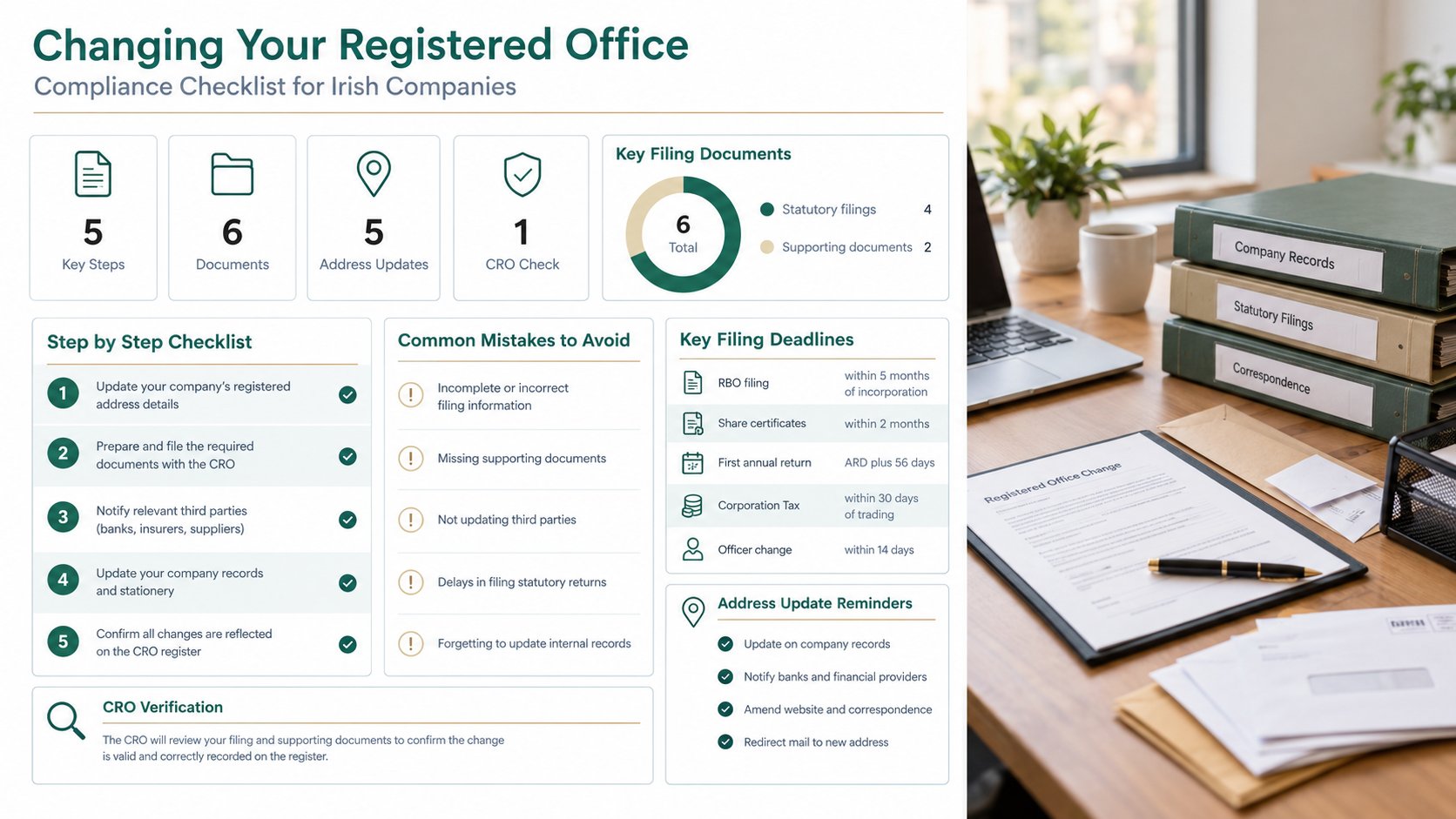
What should the company verify on the effective date?
- Board record: Minute the new address and the actual date of change.
- Premises: Confirm that post and notices can be received at the new State address.
- Form B2: File the prescribed notice through CORE within 14 days.
- Form B3: Check whether statutory registers or other section 216 records have moved.
- Company name: Display the legal company name conspicuously at the new registered office.
- Stationery: Correct letters, order forms, invoices and email templates under section 151.
- Website: Replace the former registered office details in a prominent, accessible location.
- CRO record: Verify that the Registrar has recorded the new address.
- Revenue: Update ROS and Revenue correspondence separately, while remembering that this doesn't replace Form B2.
- Bank and insurers: Notify each institution independently.
- Contracts and licences: Check landlords, insurers, regulators and other counterparties.
- Old address: Arrange redirection from the former premises and record what may have been delivered there before the change was recorded.
Common errors include using the filing date instead of the move date, selecting an address outside the State, treating a PO box as a registered office, forgetting the company's own minute book, and confusing the registered office with the principal place of business. None of those shortcuts resolves the section 51(2) service risk.
Chern & Co (RegisterCompany.ie) handles Irish company administration, including registered office arrangements and related CRO coordination. Directors, accountants and lawyers can review the available support through Chern & Co (RegisterCompany.ie), particularly where a non-resident company is moving from a co-working space, accountant's office, home address or one service provider to another.
How long does a registered office change take?
The Registrar records the change rather than approving it. The CRO publishes no processing timescale for a Form B2, so the company should check the register rather than assume one, and there is no legitimate express or priority process that changes the statutory sequence.
Does a registered office move require a members' resolution?
No. The company doesn't need a members' resolution, court sanction or constitutional amendment merely to change its registered office. The directors should record the decision and effective date in the board minutes.
Does Revenue update the CRO address automatically?
No. Revenue records through ROS, the bank, insurers and other organisations must be updated separately. The Revenue notification doesn't replace Form B2, and the CRO filing doesn't automatically update those other records.
Does changing the registered office update the RBO record?
No. The RBO records beneficial ownership, not the company's registered office. An address change alone doesn't trigger a beneficial ownership filing.
What happens if Form B2 is filed late?
The company may have committed a category 4 offence under section 50, and service at the former CRO-recorded address may remain effective until the Registrar records the new address. The company should use the true date of change and address any correspondence that may have been sent to the old office.
This article provides general procedural guidance and isn't legal or tax advice.


