Most guides on how to start a cleaning company in Ireland begin with insurance and a logo. That's backwards. The first real steps are choosing sole trader or limited company, registering any trading name with the CRO if it isn't the owner's own name, and getting tax registration sorted with Revenue.
How Do You Start a Cleaning Company in Ireland?
There's no sector licence for a general cleaning business in Ireland, so the key question is not which permit to chase. It's whether the business should start as a sole trader or an Irish LTD, because that choice changes liability, client credibility and filing work from day one.
For founders starting alone or with one or two people, the commercial reality matters more than the branding. A domestic-only cleaner can start lean, but the minute office, hotel or managing agent work is on the table, the structure and paperwork start to matter. The order that works is structure first, paperwork second, trading last, and Irish resident company formation is built around that sequence for founders who are based here.
Practical rule: do not buy vans or print uniforms before the business structure is settled. That is how owners end up repainting a logo onto the wrong legal name.
If the founder wants the filings handled, Irish resident company formation is the natural option for a limited company route, because it lines up the CRO and tax steps in the right order. That does not replace commercial judgement, but it does stop the common error of opening with the wrong entity type.
Should You Set Up as a Sole Trader or a Limited Company?
The sole trader route is simpler, but it leaves the owner exposed. The limited company route takes a bit more administration, but it separates the business from the person and is usually better received in commercial contracting, especially where facilities managers want a formal supplier on file.
| Aspect | Sole Trader | Limited Company |
|---|---|---|
| Liability | The owner is personally exposed to business debts and claims | Liability is generally ring-fenced within the company |
| Tax registration route | Registers directly with Revenue for income tax | Incorporates at the CRO first, then registers for tax |
| Contract credibility | Fine for domestic work, weaker for larger tenders | Stronger fit for office, hotel and facilities work |
| Filing obligations | Simpler ongoing compliance | Heavier filing load, including annual returns and the audit exemption risk if a return is late |
A limited company is the cleaner fit for anyone who plans to hire, tender or grow beyond a one-person round of domestic work. It also gives the business a more credible shape when dealing with property managers and procurement teams.
Where cleaning start-ups actually lose money: not on the wrong entity, but on the first office contract priced at the wrong hourly floor. The structure decision takes a week. The pay decision follows you for the life of the contract.
Whichever route is chosen, the entity has to exist before the tax registration can be made. Irish resident company formation puts the CRO step and the Revenue step in that order, rather than leaving an owner to find out halfway through that the sequence runs the other way.
How Do You Register a Business Name and Get Tax Registered?
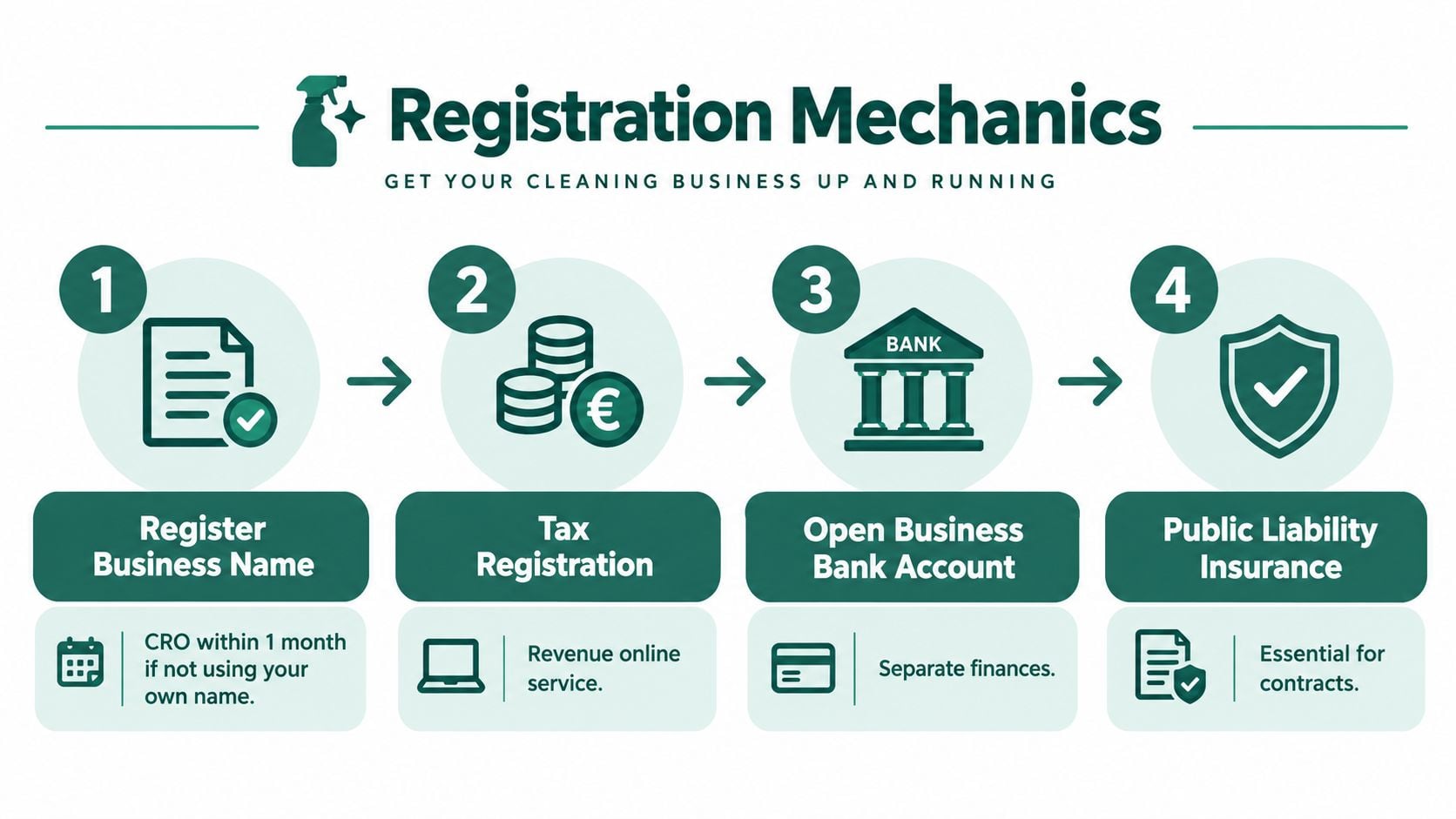
If the business trades under any name other than the owner's own true name, that name has to be registered with the CRO within one month of adoption. The forms matter. An individual uses RBN1, a partnership uses RBN1A, and a body corporate uses RBN1B, as set out on the CRO business name page. Owners often paint the van first and register the name later, which creates avoidable clean-up work.
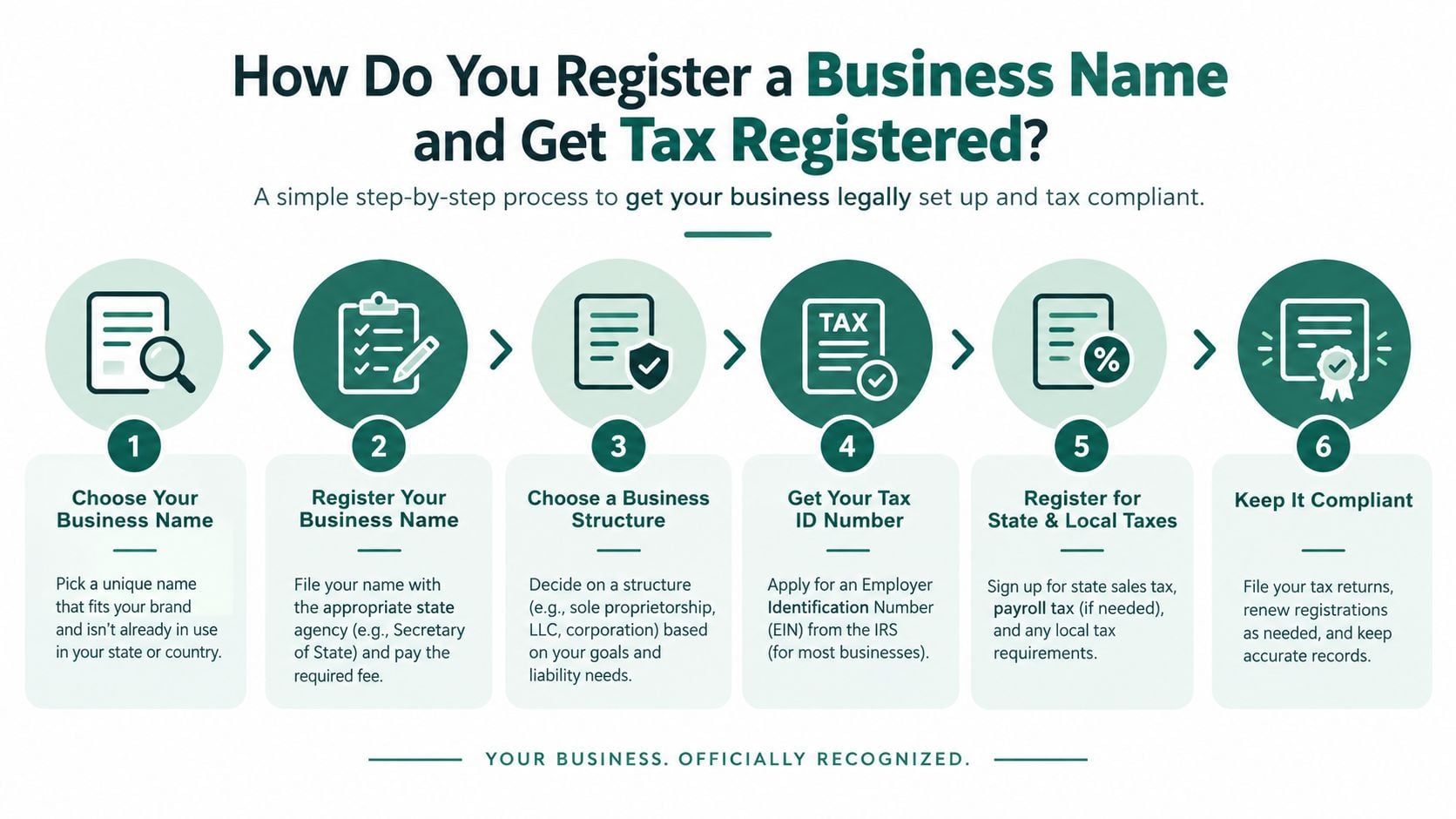
The tax sequence depends on the structure. A sole trader registers directly with Revenue for income tax. A limited company registers at the CRO first, then registers for tax. The identity point that trips many start-ups is the PPSN, because tax registration cannot complete without it and a recently arrived owner or director may need to secure that number or an Identified Person Number first.
Registration discipline matters: filing the wrong tax head creates more delay than the business name itself. A company should not be registered as if it were a sole trader, and a sole trader should not be pushed into company tax filings by mistake.
For founders who want the corporate route handled in one sequence, Irish resident company formation is the operational shortcut. It suits the moment when the business is being set up properly rather than improvised around.
What Must You Pay the Cleaners You Hire?
Contract cleaning in Ireland has its own statutory pay floor, and that is the number that drives your pricing. The Employment Regulation Order for the contract cleaning industry, S.I. No. 430/2025, in force since 17 October 2025, sets EUR 14.80 an hour for workers aged 20 and over from 1 January 2026, while the national minimum wage for the same age group is EUR 14.15. If you price office work on the lower figure, your labour cost is already wrong before you add payroll overheads.
What are the contract cleaning hourly rates from 1 January 2026?
| Worker age | ERO hourly rate |
|---|---|
| 20 and over | EUR 14.80 |
| 19 | EUR 13.32 |
| 18 | EUR 11.84 |
| Under 18 | EUR 10.36 |
The order applies to undertakings engaged in whole or in part in cleaning and janitorial services in or on the exterior of places such as hospitals, offices, shops, stores, factories, apartment buildings, hotels, airports and similar establishments. That wording matters. A business that cleans private homes only sits in a different position from one taking office or hotel work, and the phrase “in whole or in part” means a mixed business can still be caught even if domestic work is part of the mix.
The same order also carries terms owners often miss if they only check the hourly rate. Sick pay is set at 20 per cent of the basic weekly rate for up to six weeks in a rolling year, with the employee contributing 0.5 per cent of basic pay. There is also a death in service benefit of EUR 5,000 for workers with two years' continuous service in the industry, and overtime applies after 48 hours worked Monday to Sunday. Those costs belong in your quote, not in your margin.
The practical test for a new owner is simple. If the job is office cleaning, a hospital contract, or any mixed cleaning work that falls within the order, pay to the order and not to a guess. That is where first contracts become profitable or begin draining cash.
Hiring the first cleaner is also the moment the business becomes an employer, which means PAYE employer registration with Revenue before the first payslip rather than after it. Start with the labour floor and build up from there. A low headline rate looks competitive until the true employment cost lands in payroll.
Which Tax Rules Can Catch a Cleaning Business by Surprise?
Relevant Contracts Tax is the first trap. Routine office cleaning does not automatically fall into RCT, but a builders clean can change the position because Revenue treats certain cleaning work as a construction operation when it takes place in the context of construction, alteration, extension, repair, or restoration. That includes external cleaning of buildings other than ordinary maintenance, and internal cleaning carried out as part of the wider construction job.
That matters because the first post-construction clean can change the tax position mid-year. The principal contractor will usually expect the subcontractor to be RCT registered before payment, so a cleaning company that takes on one builders clean without checking the context can end up in the wrong tax lane before the invoice is settled.
What VAT threshold applies to a cleaning business?
Cleaning is a service, so the relevant domestic VAT threshold is EUR 42,500 for persons supplying services only, not the goods threshold of EUR 85,000. Many owners look at the goods figure by mistake because it seems higher, but it does not apply to cleaning.
That difference affects turnover planning. A small cleaning operation can reach the services threshold well before it feels like a large business, so VAT needs to sit beside pricing from the start, not after growth has already happened.
Revenue publishes both figures on its VAT thresholds page, which is the place to check them before registering.
Do You Need a Safety Statement and Insurance to Win Contracts?
Section 20 of the Safety, Health and Welfare at Work Act 2005 requires every employer to prepare a written safety statement based on hazard identification and risk assessment. For a cleaning business, that is not an office-only document. It has to deal with chemicals, wet floors, lone working and occasional work at height, because those are the hazards that create real liability on site.
There is one narrow easement for very small employers. If the employer has three or fewer employees, compliance can be achieved by observing the terms of a relevant code of practice relating to safety statements for that class of employment, where one exists. That is helpful, but it is not a reason to ignore the document.
Clients, tendering agents and managing agents routinely require public liability and employers liability cover as a contract condition. That is not the same thing as a legal insurance duty, but it is often the difference between being shortlisted and being ignored.
A cleaning firm without the right cover and basic written controls may be perfectly able to work, but it will struggle to win better contracts.
What Should You Do This Week to Get the Cleaning Business Moving?
Start with the structure. Choose whether the business will run as a sole trader or a limited company, then register any trading name with the CRO if you are not using your own name. After that, complete the correct tax registration with Revenue, and sort the PPSN or Identified Person Number issue before it delays the rest.
Price every labour hour against the contract cleaning floor, not the national minimum wage. If the first job may include a builders clean, check the scope before quoting, because that can change the tax treatment. Then prepare the safety statement.
For founders who want the CRO and Revenue filings handled in sequence, Chern & Co (RegisterCompany.ie) provides Irish company formation support that fits this stage of the setup. It is the practical option for owners who want the paperwork done properly while they focus on securing work and hiring their first cleaner.
Last updated: 27 September 2026.
This content is general guidance, not legal or tax advice.