Updated: August 2026. Prices, product scope and links reviewed.
A US founder usually reaches the same point before a serious move. Ireland starts as a market entry plan, then quickly becomes a residence, tax, banking and compliance project at the same time. The move is achievable, but it goes more smoothly when the personal relocation plan and the Irish company setup are handled together rather than as separate tracks.
For anyone trying to move to Ireland from the US, four issues matter most from the outset. The legal right to live in the Republic of Ireland, the right structure for employment or business, the tax position on both the personal and company side, and the practical tasks that determine whether the first months are orderly or chaotic. For non-EEA founders forming an Irish LTD remotely, the company law piece often needs attention before the flight is even booked.
Planning Your Move to Ireland from the US
A relocation from the US to the Republic of Ireland tends to fail when it is treated as one decision instead of several linked decisions. A founder may secure a role or form a company, but still be delayed by immigration permission, tax registration, housing documents or banking evidence. The strong approach is to sequence the move properly.
Three patterns usually appear. Some people move on an employment route and only later form an Irish company. Others establish an Irish LTD remotely first because they need an EU business vehicle, then organise the personal move around that structure. A third group has an Irish family connection and should verify that option before spending time on permits, in which case a specialist Irish heritage citizenship guide can be useful as an early screening tool.
The order that usually works
For most US citizens, the cleanest order is:
- Confirm immigration route. Residence permission is the essential base layer.
- Decide the business model. Employment, contracting through an Irish company, or launching a trading Irish LTD all create different compliance tasks.
- Map tax residence early. A move can create Irish filing duties while US obligations continue.
- Prepare practical evidence. Landlords, banks, immigration and service providers all ask for overlapping documents.
Practical rule: if a document may be needed in Ireland, it should be collected, certified where necessary, and stored digitally before departure.
Where founders lose time
The most common mistakes are operational rather than legal. Waiting to think about the registered office, appointing directors without checking the Companies Act 2014 position, assuming a personal bank account can be opened immediately, or treating PPSN and immigration registration as minor errands. They are not.
A move works better when each pillar supports the next. Immigration permission supports personal registration. Personal registration supports tax and banking. Proper company formation supports Revenue and CRO compliance. When those are planned together, the transition becomes manageable rather than reactive. Founders who intend to run the company remotely at first will also find the remote-first Irish company setup checklist a useful companion to this guide.
Your Legal Pathway to Irish Residency as a US Citizen
A US founder can incorporate an Irish company from abroad and still have no personal right to live in Ireland. This point is commonly missed. The company file and the immigration file may support each other, but they are separate processes with separate tests.
The practical question is simple. What permission lets you live in Ireland on the facts that apply to you? If you are relocating with a spouse, children, and a business plan to run an Irish LTD remotely at first, the answer needs to work for both your household and your operating model. That is why founders are best advised to assess residency and company setup in parallel, not one after the other.
Start with the personal permission
For many US citizens, the main route is still employment-based residence. That can work well for senior hires and for founders who will hold a genuine employed role with an Irish business. It does not follow that forming an Irish company gives you permission to reside personally. Immigration officers look at the actual arrangement, your income source, your role in Ireland, and whether the permission sought matches that reality.
For non-EEA founders, this is also the point where the company structure matters in practice. If you intend to build an Irish limited company before you arrive, an authorised Irish TCSP is often the piece that holds the remote setup together. The TCSP can help establish the company properly while your personal residency route is being handled on its own merits.
Employment permits compared
The two permits US citizens usually examine first are the Critical Skills Employment Permit and the General Employment Permit.
| Feature | Critical Skills Employment Permit | General Employment Permit |
|---|---|---|
| Best suited to | Skilled roles that fit the State’s priority categories | Roles that can be sponsored but do not fit the critical skills route |
| Main advantage | Stronger long-term position for many professionals | Wider coverage across job types |
| Application profile | Cleaner where the role and salary fit clearly | More fact-specific and often more document-heavy |
| Family planning | Often easier to align with a family move | Possible, but usually needs more planning |
| Role changes | Changes must be handled carefully | Changes also need care and can be less forgiving |
| Founder relevance | Works where the founder is taking a genuine qualifying employed role | Less common for founder-led moves unless the employment facts are very clear |
A permit only works if the day-to-day reality matches the application. If a founder says they are taking up employment but will be self-directing a newly formed company without the right structure, that inconsistency can create problems later.
Other routes worth checking early
Employment permits are not the only path.
- Family-based permission may apply if you have a spouse, civil partner, or qualifying family connection.
- Study permission can work if further education is part of a genuine relocation plan and your finances are in order.
- Irish citizenship by descent should be checked before you spend time on visa strategy if you have an Irish-born parent or grandparent.
- Investment-related routes need careful review because policy, thresholds, and availability can change.
One good ancestry result can change the whole project.
What founders should decide before booking the move
Settle three points early. First, identify the permission you will rely on personally. Second, decide whether your Irish company will be dormant at formation, trading immediately, or used as the vehicle for your own employed role. Third, confirm who will handle the Irish company compliance pieces while you are still in the US.
This avoids a common mismatch. A founder secures incorporation documents, assumes residence will follow, then discovers the personal immigration basis is weak or the intended working arrangement does not fit the permit sought. Cleaning that up after leases are signed and school places are discussed is far harder than doing the legal sequencing properly at the start.
Establishing Your Business in Ireland as a Non-Resident
For non-EEA founders, the Irish LTD is often the most efficient corporate vehicle for entering the EU market, hiring locally, or trading through an Irish entity. The legal form is familiar, credible and flexible. The difficulty is not whether an Irish private company limited by shares can be formed remotely. It can. The difficulty is getting the structure right from day one.
The main company law obstacle
Under the Companies Act 2014, an Irish company must address the requirement around an EEA-resident director. For a founder based in the US, that is usually the first substantive obstacle. If the proposed board does not include at least one qualifying EEA-resident director, the company must solve that issue through a lawful alternative, commonly a Section 137 bond or the appointment of a suitable nominee director.
Many remote formations go off course. Founders often focus on incorporation paperwork and leave the director issue until late. That tends to delay incorporation, tax registrations and bank onboarding because the file is not complete in a practical sense.
What works in practice for non-EEA founders
There are two standard routes.
- A nominee EEA-resident director. This is usually the cleaner operational solution for founders who want a fully remote setup managed by a professional provider.
- A Section 137 bond. This can be appropriate in some cases, but it is not always the most practical route for a first-time overseas founder. The comparison of the two routes sets out where each one fits.
An authorised Irish Trust or Company Service Provider, or TCSP, is often central to this process. Chern & Co Ltd is an authorised Irish TCSP, reference APP/1211/2018, and handles non-resident formations, nominee director arrangements, registered office, company secretary support, CRO filings, RBO filing and tax registrations. For this type of setup, the formation package costs EUR 3,000 for non-resident founders and EUR 2,000 for EEA-resident founders. The nominee director service costs EUR 2,000 per year.
An example of the factual service scope is Non-Resident Company Formation (All-inclusive for Non-EEA Residents), which covers CRO registration with full statutory documents, nominee EEA-resident director, company secretary and registered office for a defined period, RBO filing, Corporation Tax, PPS and Income Tax registrations and the first annual return. Founders who want a broader preparation resource can also use the full requirements checklist.
Ready-made companies can also be appropriate where speed matters more than a fresh incorporation date. A ready-made company costs EUR 5,000, or EUR 12,000 with VAT registration through the ready-made company with VAT option.
Remote formation steps
The operational sequence is easier to understand visually.
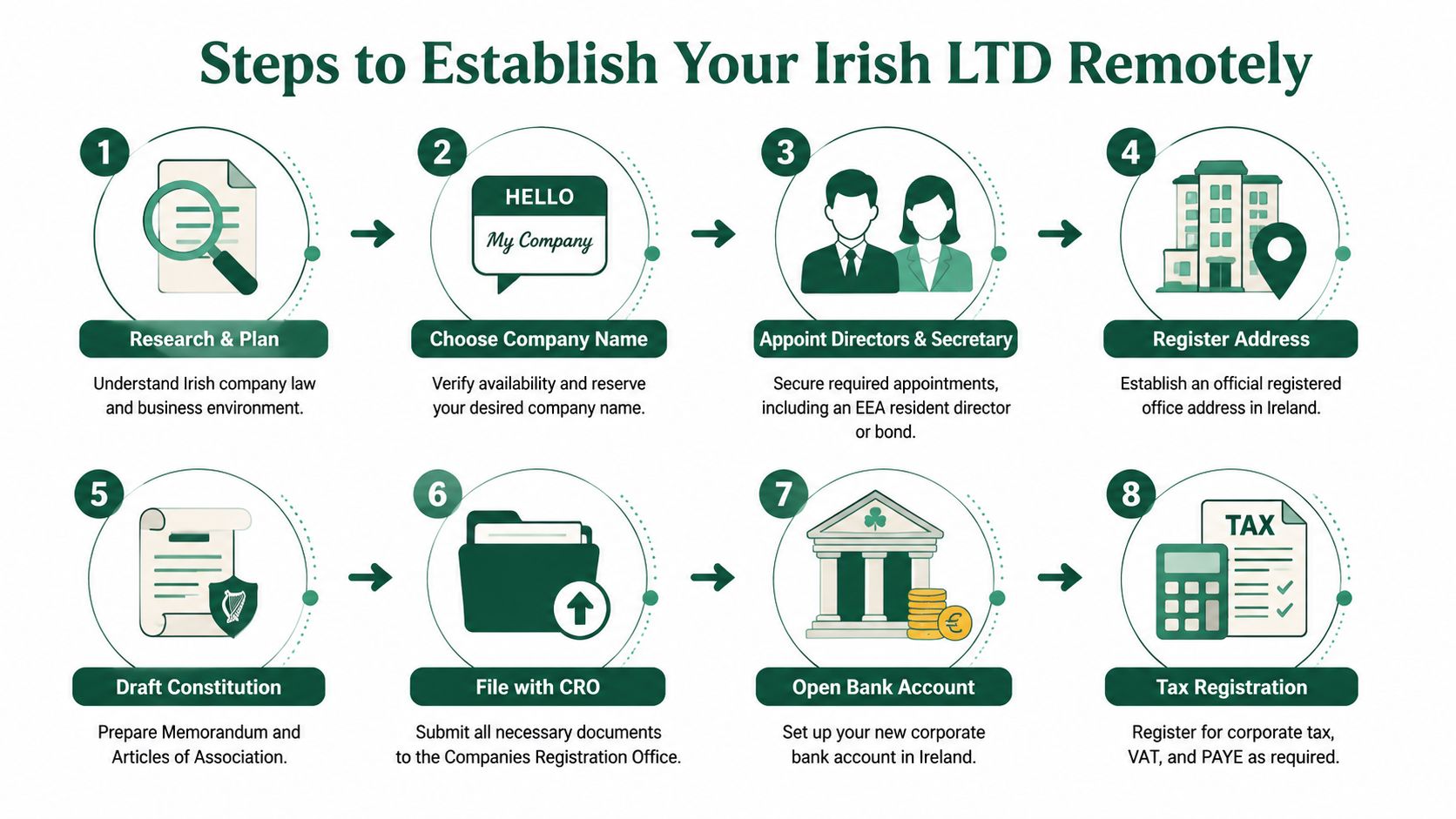
A remote Irish LTD formation usually follows this order:
- Choose the company structure. For most founders this is an LTD under the Companies Act 2014.
- Clear the director issue. Decide between an EEA-resident director arrangement or a bond.
- Prepare constitutional documents. These need to fit the actual business and governance model.
- Fix the registered office and secretary. These are not afterthoughts.
- File with the CRO. Incorporation is only one milestone, not the end of setup.
- File beneficial ownership details. This is done through the RBO.
- Register with Revenue. Corporation Tax is standard, while VAT and employer registrations depend on the facts.
- Prepare for customs if relevant. A trading company dealing with cross-border goods may also need an EORI. The official process runs through Revenue at revenue.ie; intermediary services can also handle applications through providers such as EORI.services Ireland applications.
Operational point: the fastest structure on paper is not always the safest structure in practice. A company that is incorporated quickly but incompletely usually creates more work later.
A founder who plans to move personally should treat the company file as part of the relocation file. CRO, RBO and Revenue compliance need to be clean from the start because immigration, banking, leasing and commercial counterparties often test whether the Irish presence is real and orderly. A comparable North American example is set out in our Canadian SaaS founder case study.
Understanding Your Irish Tax and Residency Obligations
A founder can have an Irish company, an Irish address, and immigration permission, yet still create a messy tax position if the personal move and the company setup are handled on different timelines. This comes up often with US founders who incorporate remotely first, then move later without revisiting how salary, dividends, consulting income, or management decisions will be taxed once they are living in Ireland.
Tax planning starts with the facts. Where you live, how many days you spend in Ireland, where the company is managed, how you draw income, and whether the business is already trading all affect the answer.
Personal tax residence
Irish immigration status and Irish tax residence are separate questions. A permission stamp lets you live in the State. It does not decide your tax treatment.
For a US citizen moving to Ireland, the first review is usually day count and pattern of presence. A short stay can become a tax issue faster than founders expect, especially where the move is gradual and the person continues to receive US income while spending increasing time in Ireland. That is why the best advice is to map the move by calendar, not by intention. Revenue and advisers work from dates, income flows, and records.
The practical point is simple. Do the residence analysis before arrival if possible, and certainly before the first Irish filing season. Waiting until bank accounts, payroll, school enrolment, and housing are already in motion usually means the tax review is happening too late.
Company taxes and registrations
For the company, three tax areas usually need early attention:
- Corporation Tax, based on the company’s profits
- VAT, if the activities and turnover require it
- PAYE, if the company pays employees or puts a director on Irish payroll
These registrations should match how the business operates, and each one carries its own place in the Irish filing calendar. A services company with one founder-director, a trading company importing goods, and a startup that is incorporated but not yet active will not be registered in exactly the same way.
This matters more for a non-EEA founder setting up remotely. The TCSP is often coordinating incorporation, registered office, company secretarial filings, and parts of the onboarding file before the founder is physically in Ireland. If the tax profile declared at setup does not match the business model you begin using after the move, the corrections can be slow and irritating. It can also complicate banking, payroll, and routine compliance.
US and Irish tax coordination
US filing obligations usually continue after the move. Irish obligations may begin at the same time. That leaves many founders with reporting duties in both countries, plus treaty analysis and foreign tax credit work to reduce double taxation where the rules allow.
Cross-border tax planning works best before contracts are signed, payroll starts, or personal income streams are mixed between the individual and the company.
The common mistake is to treat the Irish company as one project and the family move as another. In practice they are connected. If you become Irish tax resident while continuing to invoice through an existing US structure, draw funds informally from the Irish company, or make key management decisions from Ireland without documenting them properly, the paperwork gets harder and the risk rises.
The better approach is coordinated from the start. Decide how you will be paid. Decide where management decisions will be made and recorded. Decide whether the Irish company will trade immediately or remain dormant for a period while you relocate. For US founders, that joined-up plan is usually the difference between an orderly first year and a series of expensive clean-up exercises.
Managing the Practical Logistics of Your Relocation
The legal work may be precise, but the move itself usually feels messy. The first weeks in Ireland are full of small frictions, and those frictions matter because they affect whether payroll can start, whether a landlord accepts the application, and whether the household settles quickly enough for work to continue without constant interruption.
Housing and health cover

Housing is usually the first pressure point. Landlords and agents commonly want identity documents, proof of income, references and evidence that the applicant can occupy the property lawfully. A founder arriving from the US often has strong income but weak local paper trail, which can make the file look less straightforward than it really is.
That means the rental application pack should be assembled before arrival. Passport copies, employer or company documents, bank evidence, references and a concise explanation of the move help. Waiting until viewings begin usually produces rushed, inconsistent paperwork.
Healthcare is similar. Many immigration routes and practical living arrangements assume private cover is in place, at least initially. Anyone planning to move to Ireland from the US should treat health insurance as a core item, not an optional upgrade.
First administrative tasks after arrival
The first week tends to be dominated by appointments and proofs.
- Immigration registration should be booked and attended promptly where the permission requires it.
- PPSN application should be handled as soon as the individual has the basis to apply and the supporting documents ready.
- Bank account opening may take longer than expected because proof of address is often the sticking point; for the company side, see business bank account solutions.
- Utilities and local records need attention quickly because they create the documents later used for other applications.
A practical move becomes easier once one Irish proof of address is secured. That single document often unlocks the next three tasks.
A US driving licence also needs early thought. It should not be assumed that it can be exchanged in the same way as some other foreign licences. Driving, insurance and identity processes can become a hidden source of delay if they are left until a car is urgently needed.
Shipping, pets and day-one friction
Founders often plan the company setup with great care and then underestimate the household move. Shipping personal belongings, deciding what should be moved later, and checking customs treatment for personal effects all need lead time. The same applies to pets, where health certificates, transport conditions and entry rules should be verified well before departure.
The sensible approach is selective. Essential documents, devices, core business materials and immediate family necessities should travel with the person. Non-essential household goods can follow later once the address is settled and storage decisions are clearer.
What usually does not work is trying to solve everything after landing. Ireland is manageable, but the first month is easier when the file is pre-built, the documents are organised, and the founder is not depending on one last-minute appointment to make the whole move function.
Relocation Checklist and Estimated Initial Costs
A good relocation plan should be short enough to use and specific enough to catch the items that are easy to miss. For a US founder, that means separating the pre-move tasks from the post-arrival tasks, then isolating the professional costs that can be known in advance.

Pre-move tasks
- Secure the immigration basis. Residence permission should be identified and documented before travel.
- Choose the business route. Decide whether the move is employee-led, founder-led, or based on an Irish LTD formed remotely.
- Prepare company documents. If an Irish company is part of the plan, line up director, secretary, registered office and filing requirements early.
- Collect personal records. Passports, civil documents, qualifications and financial evidence should be scanned and organised.
- Arrange health cover. This often affects both immigration and practical onboarding.
- Build a rental file. Landlords respond better to applicants who can send a complete pack immediately.
Post-arrival priorities
- Complete immigration registration. Keep the permission record consistent from the start.
- Apply for PPSN. This supports work, tax and many administrative tasks.
- Open an Irish bank account. Expect proof of address to be central.
- Set up utilities and local documentation. These records often become supporting evidence elsewhere.
- Review payroll and tax registrations. For founders operating through an Irish company, this should match the actual commercial setup.
- Sort transport and driving status. It is easier to address this before it becomes urgent.
Known professional costs
Professional costs are fixed and known in advance:
| Item | Amount |
|---|---|
| Non-resident Irish company formation | EUR 3,000 |
| EEA resident company formation | EUR 2,000 |
| Ready-made Irish company | EUR 5,000 |
| Ready-made Irish company with VAT | EUR 12,000 |
| Nominee director service per year | EUR 2,000 |
Other moving costs, such as housing, flights, deposits, shipping and day-to-day living expenses, should be budgeted case by case rather than guessed. That is the safer approach for a founder household because the personal facts, location choice and family size change the picture materially.
Frequently Asked Questions
Can a US citizen work remotely in Ireland for a US company?
Not because the employer is in the US. The person still needs the correct Irish immigration permission to reside and work lawfully in the Republic of Ireland. Tax and payroll consequences may also arise for both the individual and the employer once the work is physically carried out in Ireland.
Is it better to form a new Irish company or buy a ready-made one?
A new company is usually cleaner where the founder wants bespoke constitutional documents, a fresh incorporation history and a setup designed for the intended business. A ready-made company can be practical when speed is critical, especially if a VAT-ready structure is needed, but the file still needs careful review before trading begins.
Can a US founder form an Irish LTD before moving personally?
Yes, that is often the sensible order. For non-EEA founders, the key issue is addressing the Companies Act 2014 requirement around an EEA-resident director, usually through a nominee arrangement or a Section 137 bond, while keeping CRO, RBO and Revenue filings aligned.
How long does the relocation process take?
There is no single timeline that fits every case. The immigration route, the readiness of documents, the company structure, housing availability and banking requirements all affect the pace. A disciplined file moves faster than an improvised one.
If the move involves both personal relocation and a remote Irish LTD formation, Chern & Co (RegisterCompany.ie) handles Republic of Ireland company setup for non-resident founders, including nominee director and compliance support, and can also work with accountants and lawyers acting for clients. Contact us to scope the company side of your move.
This content is general guidance, not legal or tax advice.
Forming as an EU/EEA resident? See our all-inclusive company formation package.