

An annual general meeting is a formal members’ meeting required by Irish law, and it is separate from the annual return filing with the CRO. For an Irish company, the first AGM must be held within 18 months of incorporation, and treating the B1 filing as if it were the AGM is one of the most common first-year compliance mistakes.
A non-resident founder often reaches this point with the accounts nearly ready, the CRO deadline in view, and a reasonable assumption that one annual compliance step covers everything. It doesn’t. The AGM deals with member approval and corporate governance under the Companies Act 2014. The annual return deals with public filing at the CRO.
That distinction matters most when the company is managed remotely. If the directors approve accounts but the members never formally deal with them, the statutory record is incomplete. If the B1 is filed without properly sequencing the internal approvals first, the company can create problems later in due diligence, a bank review, or an audit exemption check.
Understanding the Irish Annual General Meeting
An annual general meeting is the formal meeting of the company’s members, usually the shareholders, to deal with the company’s yearly business. In practical terms, it is where the owners consider the financial statements and review the company’s affairs in a structured way.
For a small Irish LTD, especially one owned by one founder or a small group, that formality can feel excessive. It still matters. Irish company law distinguishes between what directors do, what members do, and what the company files publicly.
Practical rule: The AGM is an internal corporate act. The annual return is an external CRO filing. One doesn’t replace the other.
That is why founders who run an Irish company from abroad need to treat the AGM as part of the annual accounts timetable, not as an afterthought. If the company keeps that sequence clear, the rest of the compliance cycle becomes much easier to manage.
Core Legal Requirements for an AGM
The legal framework sits in the Companies Act 2014. For a first-time founder, the timing point is the one to fix firmly in mind at the outset.

When the AGM must happen
Under Section 175 of the Companies Act 2014, the first AGM of a company must be held within 18 months of its incorporation. After that, no more than 15 months may pass between one AGM and the next.
That deadline catches many non-resident founders because the company may still feel new, particularly if trading started slowly or the accounts preparation took longer than expected. The legal clock still runs from incorporation. It doesn’t wait for the business to feel operationally settled.
After the first AGM, the company must keep an annual rhythm. The practical discipline is simple. The company secretary should tie the members’ approval process to the accounts process, then align the CRO filing work behind it.
What the members deal with at the AGM
The AGM is meant to cover the company’s ordinary yearly business. In a typical owner-managed Irish LTD, that usually includes:
-
Financial statements: The members consider the statutory financial statements that have already been prepared and approved at board level.
-
Company affairs: The members review how the company has been run during the relevant period.
-
Auditor matters: Where relevant, the company addresses auditor-related business.
-
Director matters: Depending on the circumstances and constitution, member action may also be needed on director appointments or related routine business.
What doesn’t work is treating the AGM as a casual email exchange with no agenda, no formal approval wording, and no record. That may feel efficient at the time, but it leaves a gap in the statutory books.
A better approach is to prepare a concise AGM pack, circulate it in one controlled bundle, and obtain signatures in the right order. Founders managing several jurisdictions at once often benefit from streamlining document collection for audits because the primary friction usually isn’t the meeting itself, but gathering the final version of every supporting document in one place.
The accounts timetable drives the AGM timetable, not the other way around.
Exemptions and Alternatives to a Physical AGM
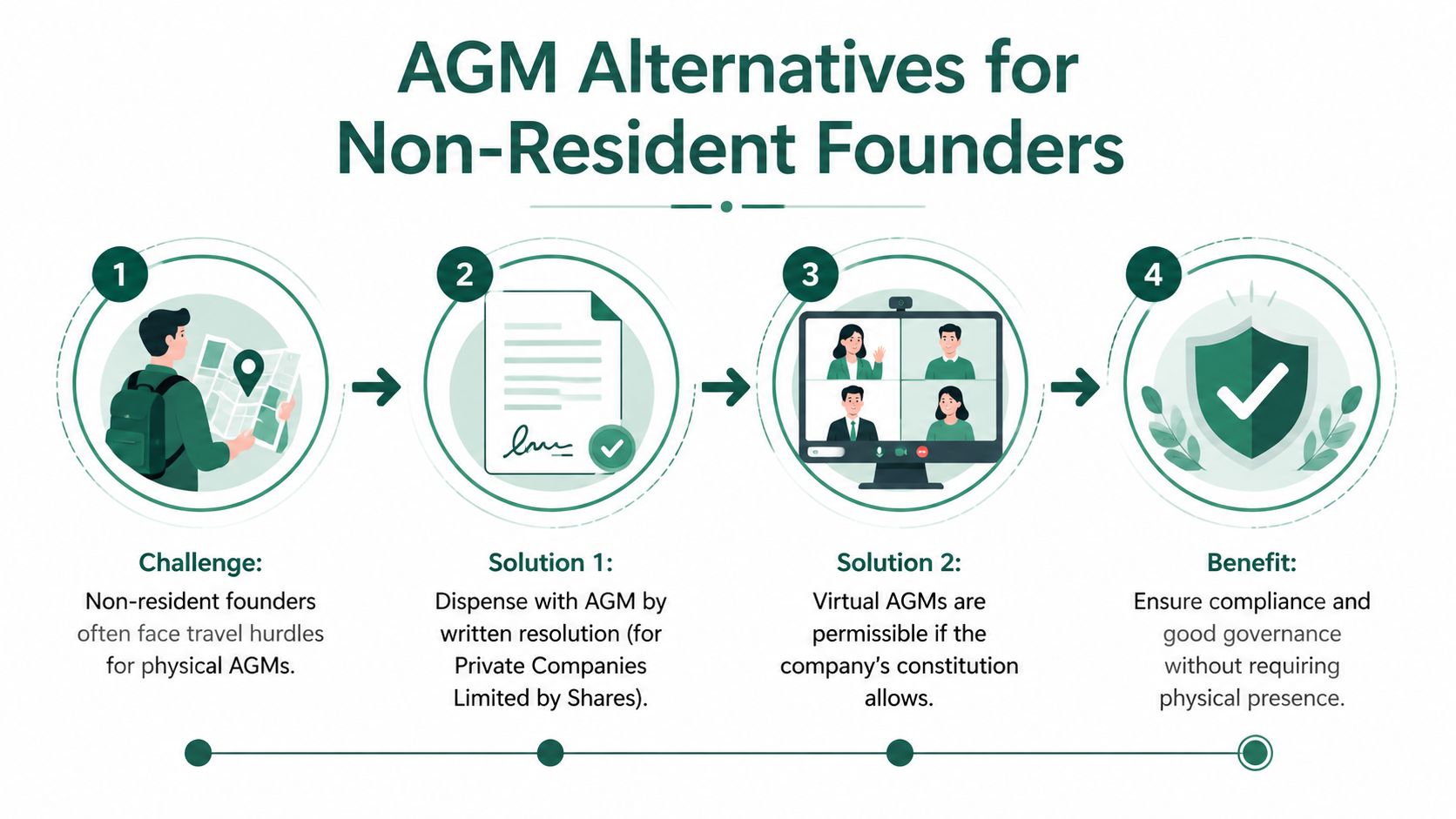
For non-resident founders, a physical meeting in Ireland often isn’t the sensible route. Irish law gives private companies more practical options, and those options are usually the right answer where the ownership is straightforward.
When a physical meeting isn’t necessary
A single-member LTD can generally dispense with holding a physical AGM and instead record the relevant member decisions in writing. That is often the cleanest route for a founder who owns the company alone and manages it from outside Ireland.
For a multi-member LTD, the usual remote solution is unanimous written resolutions in lieu of an AGM, covering the business that would otherwise be dealt with at the meeting. That preserves the corporate record without requiring travel, venue arrangements, or proxy administration for a routine owner-managed company.
Virtual participation can also be considered where the constitution allows and the meeting mechanics have been thought through properly. In practice, written resolutions are often simpler than trying to run a formal remote meeting across time zones.
What works in remote management
The sequence matters more than the format. The process usually works best in this order:
-
Directors approve the financial statements first. Members shouldn’t be asked to deal with accounts that are still changing.
-
The company secretary prepares the written resolutions or meeting papers. That pack should match the final approved accounts and any directors’ report wording.
-
Members sign and return the documents. Electronic execution is often the practical route for non-resident owners.
-
The signed papers go into the statutory records. That step is often missed, and it is where later problems begin.
For founders who want these mechanics handled in a structured way, our company secretary service includes a company secretary who manages this process.
Where a service provider is involved, this remote written-resolution model is standard. Chern & Co Ltd is an authorised Irish TCSP, reference APP/1211/2018, and this is the format typically used for non-resident-owned companies because it is procedurally cleaner than trying to recreate an in-person AGM from abroad.
The AGM Process Step by Step
Where the company does hold a formal AGM rather than using written resolutions, the procedure needs to be followed properly. The legal and practical points are straightforward, but the details matter.
How the process usually runs
A conventional AGM process usually includes the following steps:
-
Notice is given to the members: The notice should state the meeting details and the business to be transacted.
-
The agenda is settled in advance: Routine annual business should be clearly identified so members know what they are being asked to consider.
-
Quorum is checked at the meeting: The meeting can’t validly proceed if the constitutional quorum requirements are not met.
-
Voting is taken on the relevant resolutions: Ordinary business should be documented clearly, and any special business should be distinguished from routine annual matters.
-
Minutes are prepared and retained: The meeting record should reflect who attended, what was considered, and what was passed.
For absent members, proxies can be useful, especially where shareholders are spread across jurisdictions. But proxies only solve attendance and voting. They don’t fix poor preparation, missing accounts, or unclear resolutions.
Where remote founders usually get delayed
The delay point is rarely the meeting notice. It is usually one of these three issues:
-
Draft accounts are still moving: Members are circulated one version, then directors approve another.
-
The constitution hasn’t been checked: A founder assumes a remote or hybrid format is fine without reviewing the company’s own rules.
-
The statutory books are incomplete: Even if the meeting happened, the company can’t later prove what was done.
AGM vs Annual Return Filing Explained
The most frequent compliance mistake is to collapse two separate obligations into one. A founder files a B1 and assumes the AGM is dealt with, or holds an AGM and assumes the CRO filing can wait without consequence. Neither assumption is safe.
Why these obligations are often confused
Both tasks happen around the same annual cycle, both involve the company’s accounts, and both usually sit on the company secretary’s calendar. That is why they are often blended together in conversation.
Legally and practically, they are different. The AGM is about internal approval and governance by the members. The annual return is about filing information and accounts with the CRO for the public record. The company should complete the internal approval step first, then move to the filing step.
For non-resident founders, that sequence should be built into the annual checklist from day one. It is also worth reviewing the wider non-resident requirements checklist for Irish company formation because the AGM issue rarely exists in isolation. It usually sits alongside RBO, CRO, Revenue, registered office, and director residency planning.
AGM vs Annual Return Form B1 Key Differences
| Aspect | Annual General Meeting (AGM) | Annual Return (Form B1) |
|---|---|---|
| Legal basis | Companies Act 2014 | Companies Act 2014, filed with the CRO |
| Purpose | Internal meeting for members to approve accounts and review company affairs. | External statutory filing to update the public record and submit accounts. |
| Participants | Company members (shareholders) and directors. | Filed by the company or its agent, for example the company secretary. |
| Outcome | Approved financial statements and recorded minutes in the company’s statutory register. | Updated public record at the CRO. A late filing can result in penalties and loss of audit exemption. |
The practical dependency is simple. The members should deal with the accounts before those accounts are attached to the CRO filing.
What works is to treat the B1 as the filing expression of a process already completed inside the company. What doesn’t work is trying to use the filing itself as evidence that the members approved anything.
Recording the AGM and Statutory Obligations
Many first-year companies do hold the discussion, but fail on the record. That is a problem because Irish company law expects formal decisions to be recorded formally, not reconstructed later from emails and memory.

What the records should contain
The company should keep minutes of general meetings and copies of written resolutions in its statutory books. In practical terms, the record should show:
-
When the action happened: Date, and where relevant the place or format of the meeting.
-
Who took part: Members present, directors attending, and any proxy arrangements if used.
-
What documents were before the members: Usually the financial statements and any related reports.
-
What was resolved: Clear wording of each resolution passed.
-
How the company preserved the record: Signed minutes or executed written resolutions retained with the company books.
The AGM minutes themselves are not filed at the CRO. The approved financial statements are the documents that feed into the filing side of the process.
Why poor record-keeping causes problems later
Informal practice can lead to avoidable friction. During due diligence, a banking review, or any exercise that checks governance hygiene, missing AGM records stand out quickly. The issue is rarely dramatic on day one. It becomes awkward later when someone asks for the signed approval trail and none exists.
Founders handling sensitive board papers and shareholder records remotely should also think about document access controls and circulation discipline. A practical reference point is File Studio’s confidentiality guide, particularly where multiple advisers and signatories are involved across jurisdictions.
Common AGM Topics for Non-Resident Directors
The questions that come up most often are rarely about the meeting mechanics. They are usually about money and compliance risk.

Dividends and member expectations
Dividends are the item that prompts the most discussion with non-resident shareholders. The recurring question is whether the company can declare a dividend once the annual general meeting is taking place.
The careful answer is that the company should first ensure the accounts and the underlying profit position support it, and that the paperwork is internally consistent. Founders often mix dividend discussions with questions about salary extraction and personal tax treatment. Those are related, but not the same issue.
Where the shareholder is non-resident, Irish dividend withholding tax also needs to be considered. The company can explain the corporate mechanics, but the shareholder’s personal tax position should usually be reviewed with that person’s own adviser.
A dividend decision shouldn’t be bolted onto the AGM at the last minute. It should be checked against the accounts, the resolutions, and the tax handling before anything is signed.
Audit exemption and filing discipline
The second issue is audit exemption. Founders often hear that most small private companies can claim it, then assume it is automatic and durable. It isn’t. It depends on eligibility and on keeping the compliance timetable under control.
A late annual return can put audit exemption at risk. That is why the AGM and B1 cycle needs tight coordination even though they are legally separate steps. If the company leaves the approval process too late, the filing timetable comes under pressure.
For many non-EEA-owned companies, the compliance calendar is overseen with help from a resident or nominee director. A nominee company director service may be part of that structure, and the service costs EUR 2,000 per year. The practical value isn’t that the nominee attends a ceremonial meeting. It is that someone is monitoring the statutory timetable, the board approvals, and the sequencing that protects the company from preventable filing failures.
Frequently Asked Questions about Irish AGMs
What happens if we miss the AGM deadline?
Failing to hold an AGM within the statutory timeframe is a breach of the Companies Act 2014. The directors can be held responsible. The CRO can also take action, although in practice the most immediate consequence is often related to the late filing of the associated annual return, which triggers late filing penalties and can put the company’s audit exemption at risk.
Can we hold our AGM via video conference?
Yes, the Companies Act 2014 allows for meetings to be held in two or more venues using technology that provides members with a reasonable opportunity to participate. However, for most non-resident-owned companies, passing a unanimous written resolution is a simpler and more common alternative.
Does our nominee director need to attend the AGM?
While directors have the right to attend and speak at general meetings, the AGM is primarily a meeting for the members (shareholders). A nominee director’s role is focused on statutory compliance. If written resolutions are used in lieu of a meeting, the director’s involvement is in the prior step, approving the financial statements at a board level before they are presented to the members. A non-resident founder starting with a package like our Non-Resident Company Formation (EUR 3,000) will have this process managed by their company secretary.
If an Irish LTD is being managed remotely and the first AGM is approaching, Chern & Co (RegisterCompany.ie) can help put the sequence in order, from member approvals and statutory records to CRO, RBO and related compliance steps for non-resident founders and the accountants or lawyers acting for them.
General guidance only, not legal or tax advice.
Unsure about the director rule? See our guide on whether non-EU residents need an Irish resident director.


