A US founder often reaches out after a Delaware structure starts feeling like the wrong vehicle for selling into the EU. The first obstacle is immediate: an Irish LTD must have an EEA-resident director, while the founder may be sitting in Austin, Miami, or Brooklyn.
For US founders who want the residency requirement and the filings handled together rather than stage by stage, our all-inclusive formation package for non-EEA residents is built for exactly this case.
A compliant remote setup is entirely possible, but it isn’t a Delaware filing with an Irish address added afterwards. The process turns on the director-residency decision, a properly certified document pack, the CRO incorporation sequence, beneficial ownership and Revenue registrations, banking, and separate US tax advice. This guide covers each stage for founders who want to open an Irish company from the USA without treating Irish company law as an administrative formality.
Why US Founders Form an Irish LTD and What the Process Really Looks Like
Ireland appeals to US founders for structural reasons rather than because incorporation alone creates a tax result. An Irish private company limited by shares can provide an English-speaking, common-law EU base for contracting, customer support, software operations, distribution, or other commercial activity. It can also support access to the EU single market, subject to the company’s actual activities, regulatory obligations, VAT position, and place of management.
The US and Ireland already have a substantial commercial relationship. The CRO Annual Report for 2023 recorded 22,384 new Irish companies incorporated in 2023, with 306,559 Irish companies in existence at year-end. It also recorded 192 new external company registrations, including 151 from outside the EEA. Those figures show a mature registration environment, but they don’t remove statutory filing and governance obligations.
The tax distinction is equally important. The Revenue Commissioners’ corporation tax guidance states that the standard Irish corporation tax rate is 12.5 per cent for trading income, while passive income is taxed at 25 per cent. The rate depends on the nature of the profits, not on the founder’s nationality or the company’s registration certificate.
A practical remote sequence looks like this:
-
Resolve director residency first. Choose an EEA-resident director or arrange the statutory bond before filing.
-
Prepare the evidence pack. AML, identity, address, beneficial ownership, business activity, and source-of-funds documents must align.
-
Form the company. Approve the name and constitution, then file Form A1 with the CRO.
-
Complete post-incorporation registrations. Register beneficial ownership and make the appropriate Revenue applications.
-
Prepare for banking. Bank-grade KYC is usually more demanding than the incorporation filing.
-
Hand US matters to the CPA. The founder’s US adviser must analyse the foreign-company and foreign-account consequences.
The incorporation stage can move quickly once the inputs are complete. Banking and tax registration usually create the longer tail, particularly where the business model, ownership chain, source of funds, or proposed transactions need further explanation.
The EEA-Resident Director Rule and the Section 137 Decision
Section 137 of the Companies Act 2014 requires an Irish company to have at least one director ordinarily resident in an EEA state, unless the company uses the statutory alternative. The Irish Statute Book text of section 137 makes clear that the test concerns residence, not citizenship.
The Delaware mental model fails here. A US registered agent receives official correspondence for a Delaware entity, but that role isn’t an Irish director and doesn’t satisfy section 137. An Irish director has statutory responsibilities, participates in governance, and must be treated as an officer of the company, not as a postal contact.
Two lawful routes are available:
-
An EEA-resident director, who may be a genuine commercial director or a properly documented nominee. The director has legal duties and access to company information.
-
A section 137 bond, held in the prescribed form for EUR 25,000 cover, generally for a two-year term. The bond is the statutory substitute for the EEA-resident director, not an additional insurance policy alongside that requirement. The CRO’s section 137 guidance confirms that only the prescribed bond form is acceptable.
The choice should be made before documents are drafted. A nominee director introduces another person into the governance and bank-KYC file, while the bond avoids appointing an EEA-resident individual but doesn’t provide an EEA-based director who can participate in board decisions. Neither route removes the US founder’s ownership or control. The decision concerns governance, documentation, banking comfort, renewal management, and risk allocation.
| Factor | Nominee Director | Section 137 Bond |
|---|---|---|
| Statutory function | Satisfies the EEA-resident director requirement through an appointed resident director | Acts as the statutory substitute where the board has no EEA-resident director |
| Governance | Adds a director with legal duties and access to company information | Doesn’t add a resident person to the board |
| Administration | Requires appointment, ongoing approvals, and director records | Requires prescribed bond documentation and renewal monitoring |
| Banking considerations | Some institutions may find a real resident director easier to assess | The bank may request additional evidence about management and control |
| Founder control | Founder can remain director and shareholder | Founder can remain director and shareholder |
Where the founder chooses the resident director route, the appointment and the compliance oversight around it should be documented properly from the start. A bond may be more suitable where the founder wants a board made entirely of non-EEA directors, but it must be in place at incorporation and kept valid.
Section 140 provides another route where the company can demonstrate a real and continuous link with Irish economic activity and obtain the relevant statement. That isn’t a casual exemption. The company must consider whether its proposed Irish activity, contracts, operations, and supporting evidence can withstand scrutiny.
Practical rule: Decide between the resident director and bond before the AML pack is finalised, because the choice affects the board file, the incorporation documents, and the bank application.
The US Document Pack and Where Founders Trip Up
The US founder’s document pack should be assembled as one coherent file rather than sent in instalments. The usual material includes a passport copy, residential address evidence, director and shareholder details, beneficial ownership information, a description of the proposed business, and source-of-funds evidence. If an existing US entity is contributing assets or becoming part of the ownership structure, certified corporate documents may also be needed.
The most common address mistake is treating a US driving licence as sufficient proof of address. It can function as an identity document, but it isn’t a substitute for separate residential address evidence in an Irish AML file. A recent utility bill, bank statement, or government letter is normally more useful, and the document should show the founder’s full name and residential address clearly.
Screenshots create another avoidable problem. A cropped online banking image may show an address, but a full original PDF statement is more likely to meet a certification or KYC request. Names must also match across the passport, address evidence, incorporation forms, ownership records, and source-of-funds explanation.
Apostilles and certification need a jurisdiction-specific route
US founders often expect one federal office to handle every apostille. The correct route depends on the document. A document issued by a US state generally goes through the Secretary of State of that issuing state, while federal documents follow the federal route. A county clerk isn’t a universal substitute, and the required certification may differ depending on whether the document is intended for the CRO, a bank, or another regulated institution.
The pack should answer four questions before submission:
-
Who owns the Irish company? Provide the direct and indirect ownership chain.
-
Who controls it? Identify the natural person or persons who ultimately control the company.
-
What will it do? Explain products, customers, territories, expected flows, and contracting arrangements.
-
Where did the funds come from? Give a concise, document-backed explanation rather than a generic statement.
The non-resident requirements checklist can help organise the evidence before the regulated intake begins. A non-resident formation service may also coordinate the CRO, registered office, company secretary, RBO, and tax-registration workflow, but the founder remains responsible for supplying accurate information.
Missing dates, inconsistent spellings, unclear ownership, and incorrectly certified documents cause more delay than the electronic filing itself. The fastest preparation is usually boring preparation, one complete pack, one consistent name format, and source-of-funds evidence ready before a reviewer asks for it.
The Remote Formation Sequence From AML to CRO Incorporation
Remote formation starts with regulated onboarding, not with a name search. An authorised Irish TCSP, such as Chern & Co Ltd, must complete AML and KYC checks before accepting the formation instructions and preparing the final filing pack.
The sequence is connected:
-
TCSP engagement. Confirm the intended activity, ownership, director route, registered office, and company secretary arrangements.
-
AML and KYC intake. Supply identity, address, beneficial ownership, and source-of-funds documents.
-
Name and constitution. Check the proposed name and prepare the single-document constitution for an LTD.
-
Form A1 filing. Sign and submit Form A1 through the CRO’s electronic incorporation route.
-
RBO registration. File beneficial ownership information with the central register within the applicable statutory period.
-
Revenue registrations. Consider corporation tax, employer registrations, VAT, and other obligations based on the business model.
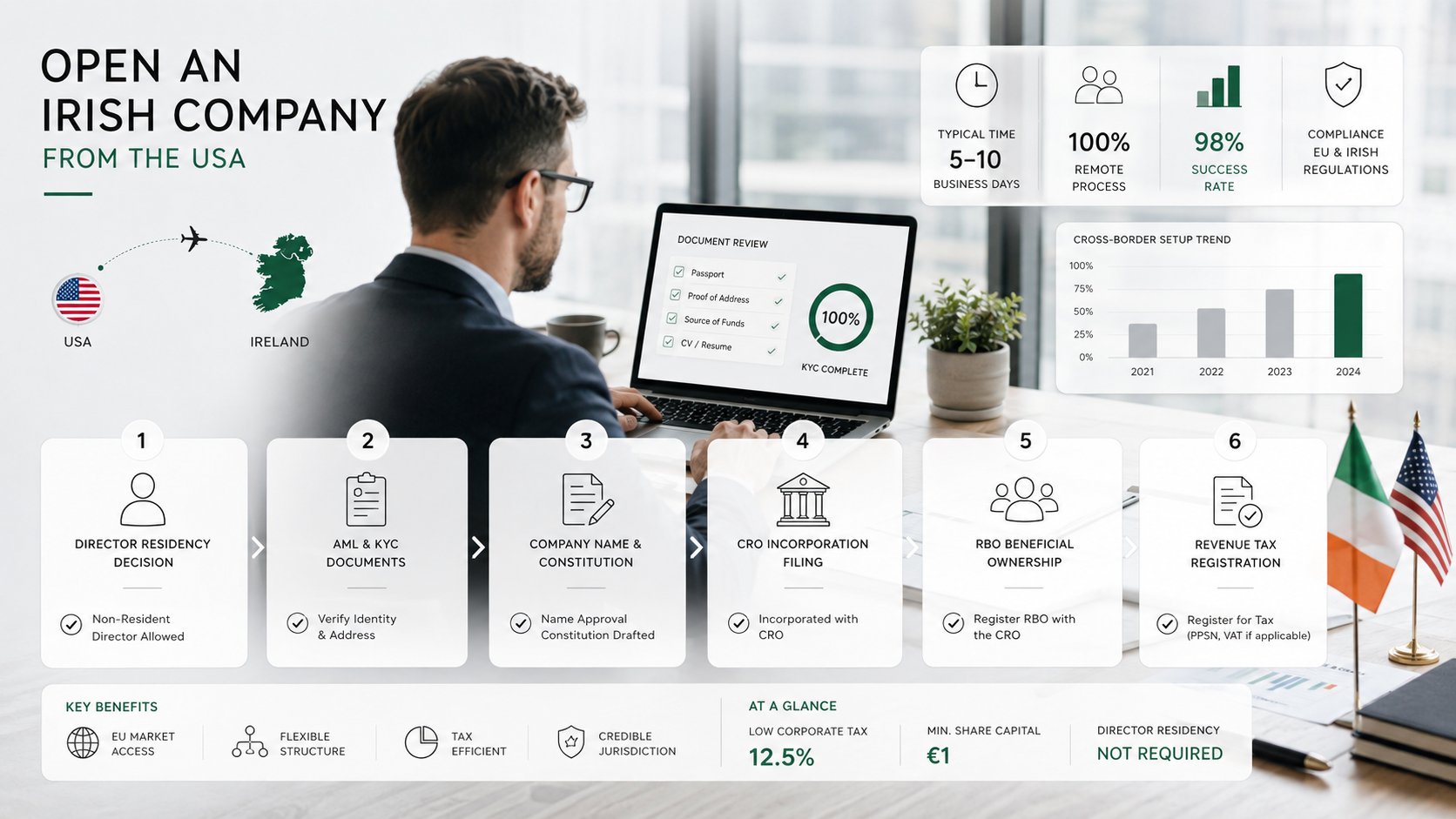
The CRO’s review is only one part of the timetable. The CRO does not publish a guaranteed turnaround, and any figure quoted for expedited processing applies to the CRO stage alone. The front end usually takes longer where the founder must obtain certified identity documents, resolve an address issue, or arrange the section 137 bond.
CRO incorporation isn’t the end of the process. The RBO filing identifies the natural person who ultimately owns or controls the company, and the company then needs appropriate Revenue registrations before trading activities begin. A business requiring VAT registration should treat that as a separate Revenue workstream, not as an automatic consequence of incorporation.
Post-Incorporation in Ireland and US-Side Matters for Your CPA
Irish and US compliance should be separated immediately after incorporation. The Irish company needs its CRO, RBO, Revenue, registered-office, secretary, accounting, and annual-return records maintained under Irish rules. The US founder’s CPA must separately assess how the ownership and activity affect the founder and any US entity.
Irish obligations belong in the company’s compliance calendar
The Irish company should maintain accurate registers and notify the CRO of changes through the relevant forms. Board resolutions themselves aren’t filed with the CRO, but consequential changes and members’ special resolutions may require filings. Directors’ fiduciary duties are codified in section 228 of the Companies Act 2014, and those duties apply regardless of whether the founder lives in the US.
The first AGM falls within 18 months of incorporation, and no more than 15 months may pass between AGMs. Annual returns must be prepared and filed on time, because a late annual return can put the audit exemption at risk. An Irish LTD has no minimum share capital, but that doesn’t mean the company can operate without proper ownership records, accounting records, or evidence supporting its transactions.
Beneficial ownership is another distinct filing. RBO guidance treats control of more than 25 per cent of voting rights or ownership interest as a relevant indicator, including ownership represented by 25 per cent plus one share. The RBO guidance on beneficial ownership should be checked against the actual ownership chain.
| Workstream | Ireland, TCSP and company | US, founder’s CPA |
|---|---|---|
| Company formation | CRO incorporation, constitution, officers, and statutory registers | Analyse the US owner’s classification and reporting position |
| Beneficial ownership | RBO filing and updates when ownership or control changes | Assess any US disclosure consequences |
| Tax | Revenue registrations for corporation tax, PAYE, and VAT where relevant | Review foreign-company reporting and US tax treatment |
| Banking | Irish account onboarding and source-of-funds evidence | Review foreign-account reporting exposure |
| Ongoing governance | Annual returns, AGMs, accounts, director duties, and company records | Coordinate US filing dates with the Irish compliance calendar |
US matters must go to the founder’s own adviser
A US person who owns an Irish company may have US reporting obligations connected with a foreign corporation. Foreign financial accounts may create separate reporting obligations when the relevant conditions are met. The founder’s CPA should review the ownership structure before incorporation rather than discovering it during the next filing season.
The CPA should also assess the Ireland-US double taxation treaty and the appropriate US tax classification. No Irish formation provider should decide whether a US entity requires a particular election, whether income is attributed to the owner, or how controlled foreign company rules apply.
The W-8BEN-E should be prepared early where US customers or counterparties request it before paying an Irish invoice. It supports the customer’s withholding documentation process, but it isn’t a ruling on the company’s Irish tax residence or a replacement for US tax advice.
Banking, Timelines, and the Realistic Cost of Doing It Right
Banking is often the slowest stage for a US founder. The incorporation certificate proves that the Irish company exists, but a financial institution still needs to understand the business model, ownership, expected transactions, source of funds, management location, customers, and proposed use of the account.
A traditional Irish bank may require an in-person visit to the branch where the relationship is opened. A remote-friendly electronic money institution may accept an application online, but approval, account functionality, payment limits, and merchant-acquiring options depend on the institution’s own risk assessment. The company should not promise customers a banking date before that assessment is complete.
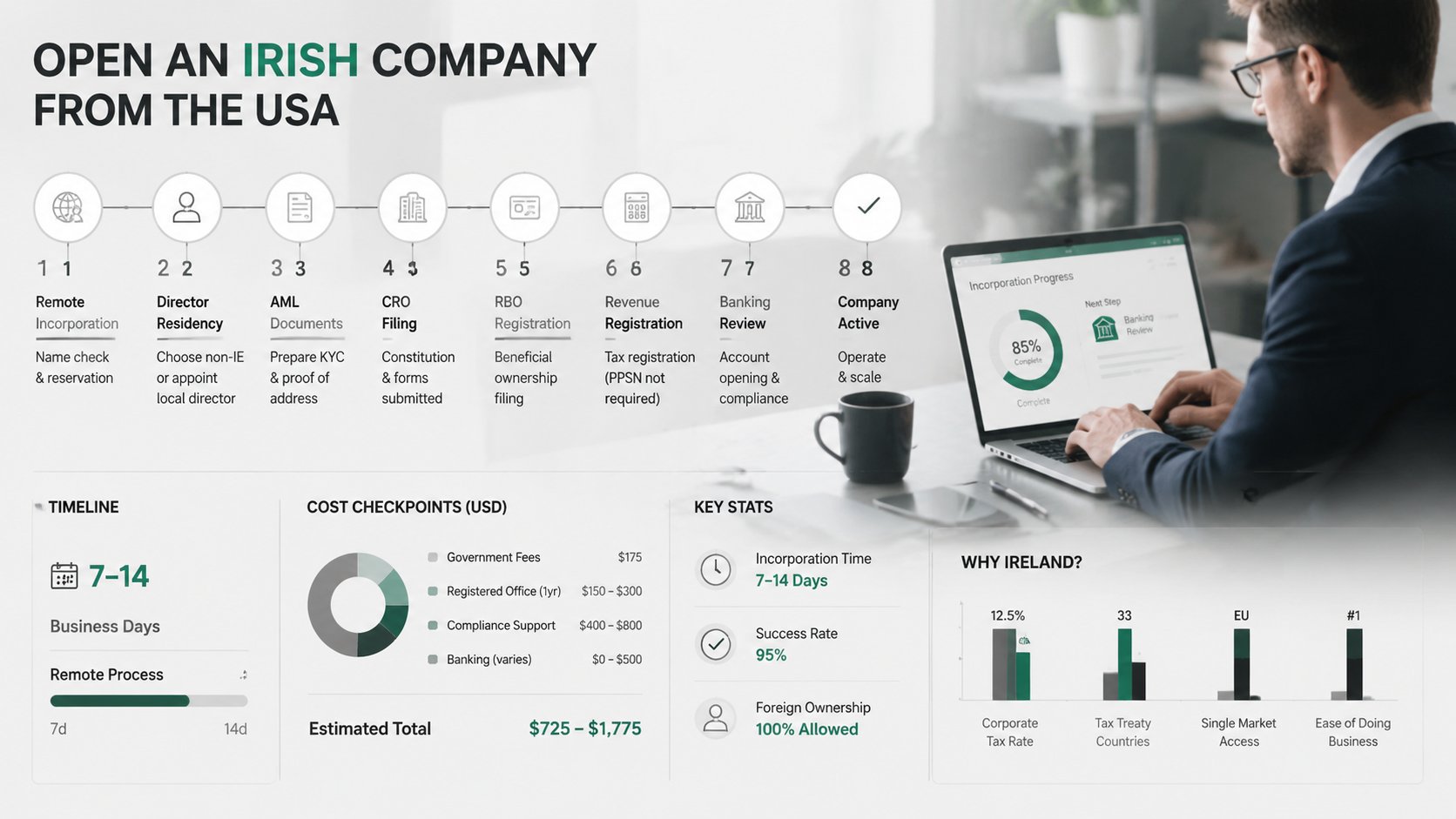
The practical cost picture also needs discipline. The non-resident formation package is a fixed price including an EEA-resident director for the first year, while a resident director service is a separate annual fee thereafter. A section 137 bond provides EUR 25,000 cover for a two-year term, with the premium set by the third-party insurance arrangement rather than equal to the cover amount.
Banking reality: A company can be legally incorporated while its operating account remains under review. Trading plans should allow for that distinction.
The front end moves faster when the founder supplies a complete certified pack, uses the same name spelling everywhere, explains the source of funds clearly, and chooses the director route before the constitution is prepared. Banking can still take longer because the institution may ask questions that the CRO doesn’t ask, particularly about US customers, payment flows, ownership, and where decisions are made.
The company also needs to distinguish registration from tax residence. Revenue states that residence turns on where central management and control is performed, with relevant factors including where major policy decisions are made, where directors live, where contracts are negotiated, and where head-office functions sit. A founder who directs everything from the US may create Irish, US, or dual-residency questions that incorporation alone doesn’t answer.
Common Questions From US Founders and the Next Step
Can a US citizen own 100 per cent of an Irish company?
A US citizen can own all the shares of an Irish LTD, subject to AML, beneficial ownership, tax, and banking checks. Ownership doesn’t remove the section 137 requirement, so the company still needs an EEA-resident director or a valid section 137 bond unless the company qualifies through the genuine and continuous link route.
Does a US registered agent satisfy the Irish director requirement?
No. A US registered agent is a US-jurisdiction role and isn’t an EEA-resident Irish director. Section 137 concerns the residence of a company director, so the founder must make the resident-director or bond decision before filing.
Does the founder need to visit Ireland to form the company?
The incorporation process can be completed remotely when the required documents are properly certified and the filings are accepted. Banking may have separate attendance requirements, so remote formation shouldn’t be treated as a promise of fully remote banking. A founder considering personal relocation should use the separate guide to moving to Ireland from the US and obtain immigration advice separately.
Is an Irish company taxed in the US?
An Irish company can create US tax and reporting consequences for its US owners, but the answer depends on the ownership, management, activity, entities involved, and applicable US rules. The founder’s own CPA should analyse foreign-corporation reporting, foreign-account reporting, treaty treatment, and any controlled foreign company exposure. Irish incorporation isn’t a substitute for that analysis.
A formation scoping call should resolve the director route, ownership chain, document pack, intended activity, registered office, Revenue registrations, and banking plan before filing begins. Chern & Co Ltd is an authorised Irish TCSP, reference APP/1211/2018, and provides remote Irish LTD formation and related compliance coordination for non-EEA founders.
Chern & Co can assess the proposed structure, arrange the appropriate EEA-resident director or section 137 bond route, prepare the CRO and RBO filings, and coordinate the initial Irish registrations. Visit Chern & Co (RegisterCompany.ie) to start with a formation review based on the company’s ownership, activity, and US operating plans.
This content is general guidance, not legal or tax advice.