

Last updated: 21 September 2026
Most advice on this point is incomplete. For an Irish LTD with no EEA-resident director, there are three routes, not two, and the least documented is the section 140 certificate on Form B67.
That third route matters, but it is often misunderstood. It is not a shortcut around section 137. It is a narrow statutory exemption that works only where the company can already prove a real and continuous link with economic activity in Ireland, and it stays alive only while that link continues.
What Are the Three Routes Around the EEA-Resident Director Rule in Ireland
Founders are often told there are two ways around the EEA-resident director rule. In practice, there are three, and the third route is the one that gets oversold and under-explained.
Section 137(1) of the Companies Act 2014 requires at least one director of the company to be resident in an EEA state, subject to the statutory exceptions. If the company has no EEA-resident director and no valid route around that requirement, section 137(6) makes the breach a category 4 offence.

What are the three lawful routes
The first route is to appoint at least one director who is resident in an EEA state. Sometimes that is a genuine founder or senior team member. Sometimes it is a formal Nominee / Resident Director Service (Section 137 compliance) where an EEA-resident nominee director is appointed.
The second route is the section 137 bond. A company with no EEA-resident director can maintain the prescribed bond instead. The bond is a compliance tool, not evidence of Irish trading substance, and it is often the practical answer at incorporation where the business has not yet built an Irish footprint.
The third route is the section 140 certificate. This is the point many non-EEA founders hear too late. It is not an alternative in the casual sense of "pick any document you like". It is the third statutory route, and it only works where the company can already prove a real and continuous link with economic activity in Ireland.
That difference matters in real filings.
A resident director route depends on a person. A bond depends on the prescribed insurance instrument. A section 140 certificate depends on evidence, and the evidence must line up within a tight sequence, including the Revenue statement that has to fall inside the two-month window before the B67 application.
Why founders misjudge the section 140 route
The mistake usually happens at timing.
At setup stage, many non-EEA founders have a plan to trade in Ireland, open a local operation, or hire staff. That may be commercially credible, but planned activity is not the same as an existing real and continuous link. For a B67 application, the Registrar looks for present facts, not future intention.
I see the same trade-off repeatedly. If the company needs to incorporate now and start operating before it has Irish trading evidence, the practical route is usually an EEA-resident director or a bond. If the company already has Irish substance, such as actual trading, an established place of business, or it falls within one of the other statutory conditions, section 140 may be available. Even then, the certificate is a status the company has to keep, because revocation risk under section 140(6) is the part many guides barely mention.
That is why I treat section 140 as the third route to plan into, not a document to buy at the start.
What Does the Section 140 Certificate Actually Disapply in Ireland
A section 140 certificate only disapplies one requirement. That narrow effect is exactly why applicants misread it.
Under section 140(1), section 137(1) does not apply to the company while the certificate is in force. In practical terms, that means the company is relieved from the requirement to have at least one EEA-resident director for that period. Nothing else falls away.
That point matters because founders often treat the certificate as if it regularises the whole position of a non-EEA-led company. It does not. It is a statutory exception to one director residency rule, and only for so long as the company continues to qualify.
The CRO's own guidance reflects that limited effect. Once granted, the company is exempt from the EEA-resident director requirement from the date of issue, and only while the certificate remains in force. The legal basis sits in Companies Act 2014, section 140, which allows the Registrar to issue a certificate where the company has a real and continuous link with one or more economic activities being carried on in the State.
That wording does real work.
It means the certificate is not an alternative version of incorporation. It is the third route around section 137, available where the company can prove an existing Irish economic link and keep proving it if challenged later. In live files, that distinction is more important than the grant itself, because weak assumptions about ongoing eligibility are what create revocation exposure under section 140(6).
What the certificate does not disapply
The certificate does not waive general company law compliance.
It does not alter tax obligations, annual return requirements, governance duties, or record-keeping obligations. It does not deal with beneficial ownership filing either. The beneficial ownership regime sits separately, and the RBO online filing system still applies where the company is in scope.
It also does not turn a registered office or service address into a real and continuous link. I see this mistake often. An Irish address can support a file, but by itself it proves very little for section 140 purposes.
Just as the certificate does not help a company whose Irish activity is still only planned. If the business is pre-trade, has no present Irish operation, and cannot yet support one of the statutory conditions, section 140 is usually the wrong filing at that stage. As noted earlier, that is when the practical route is often to put another compliant structure in place first and revisit B67 only once the Irish evidence exists.
Which of the Four Conditions in Section 140(9) Can the Company Rely On
Many applications go wrong. Section 140(9) gives four alternative conditions, and any one of them is enough. The file should be built around the condition the company can prove, not around a vague story about future plans.
What does section 140(9) actually say
The four conditions are:
Section 140(9)(a), the affairs of the company are managed by one or more persons from a place of business established in the State and that person or those persons is or are authorised by the company to act on its behalf
This suits a company that is managed from an Irish place of business by an authorised person. The address alone is not enough. The authority point must also be real.Section 140(9)(b), the company carries on a trade in the State
This is often the cleanest route. Ordinary trading records usually do more work here than any covering note.Section 140(9)(c), the company is a subsidiary or a holding company of a company or other body corporate that satisfies either or both of the conditions specified in paragraphs (a) and (b)
This is the group route. The evidence has to show both the group relationship and the qualifying position of the related entity.Section 140(9)(d), the company is a subsidiary of a company, another subsidiary of which satisfies either or both of the conditions specified in paragraphs (a) and (b)
This is another group structure route, usually relevant where a sister company in the same group has the Irish management or trade footprint.
Files that describe what the company intends to do tend to struggle. Files that show what the company already does in Ireland tend to stand up better.
Which condition usually works best in practice
Condition (b) is often the most straightforward because the documents are the argument. Invoices, contracts being performed in Ireland, bank activity connected to that trade, payroll where relevant, and recent financial statements usually show more than a long explanation ever will.
Condition (a) can work, but it is frequently overstated. A place of business in Ireland without an authorised person managing the company from there does not satisfy the condition as drafted.
What does a useful comparison look like
| Statutory condition | Plain-English gloss | Typical evidence |
|---|---|---|
| Section 140(9)(a) | Management from an Irish place of business by an authorised person | Evidence of the place of business, evidence of actual management there, evidence of authority to act |
| Section 140(9)(b) | The company is carrying on a trade in Ireland | Trading records, contracts, invoices, bank activity, payroll or subcontracting records, recent financial statements |
| Section 140(9)(c) | Parent or subsidiary relationship with a company that meets (a) or (b) | Group structure documents plus evidence that the related company satisfies (a) or (b) |
| Section 140(9)(d) | Sister-company route within a qualifying group | Group structure documents plus evidence that another subsidiary satisfies (a) or (b) |
How Do You Sequence the Revenue Statement and Form B67 Inside the Two-Month Window
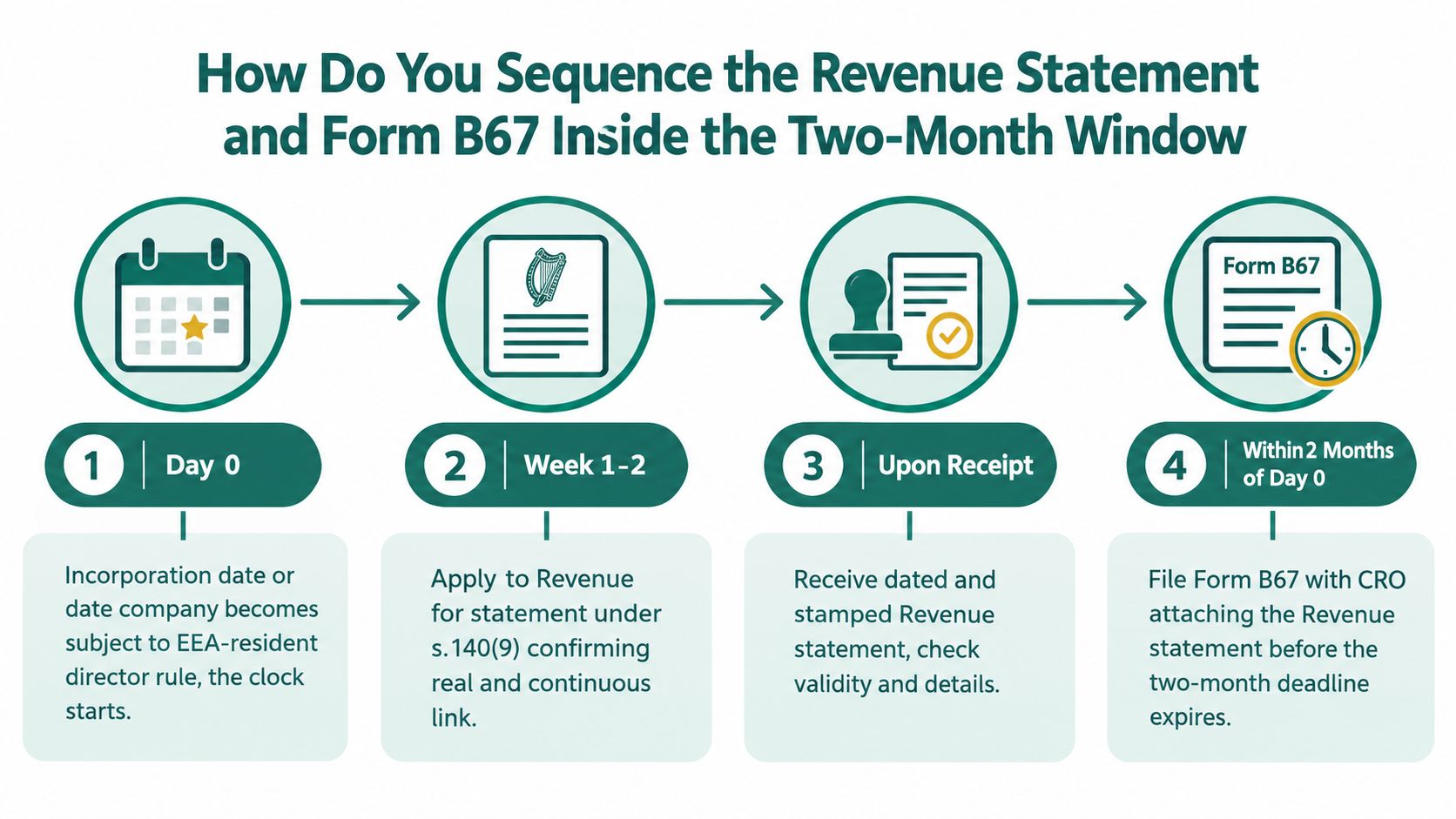
This is the operational detail that breaks plans. The issue usually is not the B67 itself. It is the date arithmetic.
What has to happen first
Under section 140(4) and section 140(5), a statement in writing given to the company by the Revenue Commissioners, within the period of 2 months ending before the date on which the application is made, stating that Revenue has reasonable grounds to believe that the company has a real and continuous link with one or more economic activities being carried on in the State, is deemed to be proof for the purpose of section 140(3).
Section 140(3) is strict. The Registrar shall not grant the certificate unless the company tenders proof that it has such a link.
In practice, that means the sequence is:
- Decide which section 140(9) condition is being relied on
- Obtain the Revenue statement
- File Form B67 with the CRO while that statement is still within the two-month window
The CRO's own guidance in Information Leaflet 17 confirms that the application is made to the CRO on Form B67 and must be accompanied by a Revenue statement made within two months of the date of the application to the CRO.
How should the two-month rule be read
Plainly, at the date the B67 reaches the CRO, the Revenue statement must be no more than two months old.
That sounds simple, but applications drift. Signatures take time. Supporting papers are chased. Someone assumes the statement can sit on file until everything else is ready. It cannot.
Date arithmetic should be checked last, by someone other than the drafter. A complete file with a stale Revenue statement is still not a workable filing.
What evidence usually helps the most
The strongest evidence is usually the least theatrical. Recent financial statements, ordinary trading records, and documents that match the chosen condition tend to work better than broad assertions of Irish intention.
The B67 route is also formal. The CRO Form B67 makes clear that it is the prescribed application for a certificate under section 140, which reinforces that this is not an informal concession.
Why Is Revocation Under Section 140(6) the Real Risk to Plan Around
This is the honest heart of the route. The certificate is not a document to buy once. It is a status to keep.
What does the Act say about revocation
Section 140(6) says that if the Registrar forms the opinion that the company has ceased to have a real and continuous link with any economic activity being carried on in the State, he or she shall revoke the certificate. Not may, shall.
That changes how the route should be assessed. The company is not only proving a link at the start. It is accepting that the exemption stands only while that link remains real and continuous.
How can Revenue trigger that process
Section 140(7) and section 140(8) matter because they give Revenue a live role after the certificate is granted. Revenue may give notice in writing to the Registrar that they are of the opinion that the company has ceased to have that link, and that notice constitutes information in the possession of the Registrar for the purposes of section 140(6), notwithstanding secrecy obligations.
The risk profile is not at filing stage alone. Revenue can be the source of the opinion that starts the revocation.
What does that mean in practical terms
A company built around section 140 must keep the Irish activity visible and defensible. If the trading stops, the management footprint leaves the State, or the group condition being relied on falls away, the certificate is exposed.
That is why this route suits established substance better than planned substance. Founders who only need a compliant route into incorporation usually need a different structure at the outset and should choose it consciously, rather than trying to stretch section 140 beyond what the Act supports.
How Do the Resident Director, Section 137 Bond and Section 140 Certificate Compare
The cleanest comparison is not speed or cost. It is what each route demands at the outset, and what it demands afterwards.
What are the practical trade-offs between the three routes
| Criterion | EEA-resident director | Section 137 bond | Section 140 certificate |
|---|---|---|---|
| What it demands at the outset | A person who is resident in an EEA state | The prescribed bond under section 137(2), to the value of EUR 25,000, valid for a minimum of two years | A real and continuous link with economic activity in the State that already exists and can be evidenced |
| What it demands afterwards | The person must remain in place or be replaced compliantly | The bond must remain in force while needed | The link must continue, because the certificate is revocable under section 140(6) |
| Irish connection required | The route itself does not require proof of Irish trading | No connection with Ireland is required by the bond itself | The route depends on actual Irish economic substance |
| Typical weakness | Treating the appointment as nominal rather than real | Assuming the bond solves anything beyond section 137 compliance | Treating the certificate as a filing event instead of an ongoing status |
A section 137 bond is the insurance instrument itself, not a separate concept floating around the board structure. For founders comparing routes, the current structure of that option is set out on the section 137 bond page.
Which route is the most misunderstood
The certificate, by some distance.
A resident director demands a person. The bond demands no connection with Ireland at all, it substitutes money for the connection, for a minimum of two years. The certificate demands a link that already exists and can be evidenced, and it demands that the link continues.
That is why the right description is simple. The certificate is not a document you buy once, it is a status you keep.
What Does a Practical Section 140 Checklist Look Like Before Filing the B67
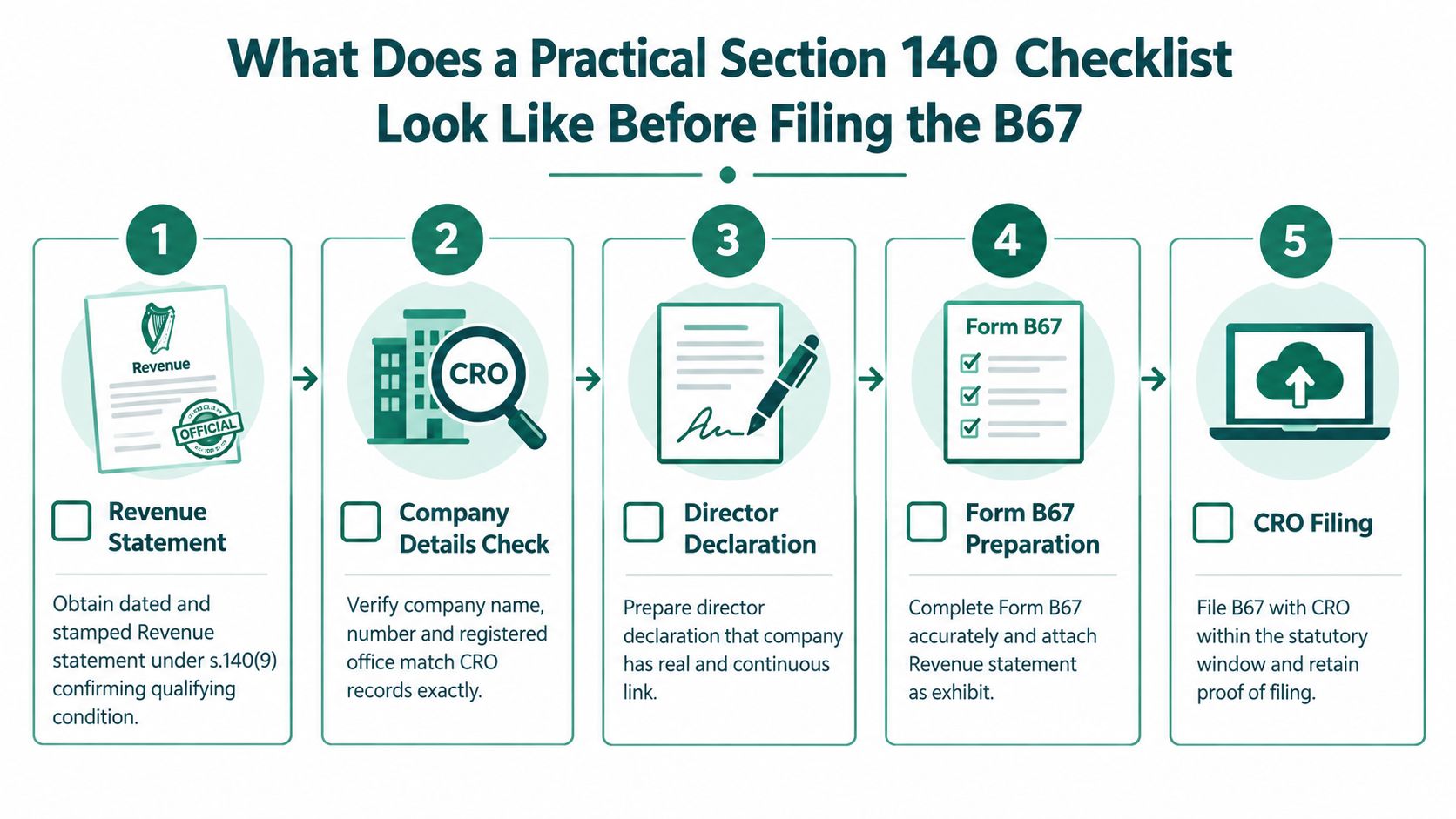
The practical mistake is usually timing, not paperwork. Founders focus on the B67 itself and treat the Revenue statement as an attachment to collect later. In practice, the Revenue statement controls the filing sequence because the B67 has to reach the CRO within two months of that statement. Miss that window and the file is stale before it starts.
What should be checked before the B67 is filed
Use a checklist that follows dependency, not theory.
- Choose the section 140(9) condition first: decide which statutory condition the company can prove before asking Revenue for anything.
- Test the evidence before the Revenue step: if the file only shows future intention, early setup activity, or generic Irish service providers, it is usually not ready.
- Get the Revenue statement at the right point: too early is as risky as too late because the two-month clock starts running from the date of that statement.
- Match the evidence to the route relied on: a trading case needs trading evidence. A management-and-control case needs proof of the place of business in the State and proof that real authority is exercised from there.
- Check the CRO details line by line: company name, number, and filing particulars need to match the CRO record exactly.
- Diary the filing window immediately: count the deadline as soon as the Revenue statement issues, then work backwards from the CRO filing date.
- Keep a clean record set after filing: retain the Revenue statement, the B67, and CRO filing proof because the certificate only helps while it remains in force.
A good file is dated, specific, and consistent. Overloaded files often fail because they mix several theories and prove none of them properly.
Can a newly incorporated company usually rely on section 140 immediately
Usually no.
A new company may have an Irish plan, an Irish adviser, and an Irish registered office, but that is not the same as a real and continuous link with economic activity in the State. For many non-EEA founders, the sensible route at incorporation is to use one of the other section 137 compliance options first, then revisit section 140 later if the Irish trading or management position becomes real enough to evidence.
That is the point many applicants miss. The certificate works best as the third route once substance exists, not as a shortcut at day one.
What happens if the Revenue statement goes stale before filing
The application needs to be reset.
This is a common failure pattern in live files. Revenue issues the statement, directors delay signing, supporting documents are revised, or the B67 sits in a queue, and the two-month period closes. Once that happens, the practical answer is to obtain a fresh statement and file within the new live window.
Does the certificate remove any obligation beyond section 137(1)
No. Its effect is narrow.
It disapplies section 137(1) while the certificate is in force. It does not remove filing, tax, beneficial ownership, accounting, or governance obligations, and it does not protect a company whose Irish link later weakens to the point that section 140(6) becomes a live risk.
Does a change of director end the certificate automatically
A director change does not decide the point by itself.
The question is whether the company still satisfies the basis on which the certificate was issued. If the original file depended on substantive activity, Irish management functions, or another qualifying condition under section 140(9), that position needs to continue after the change. This is why I treat post-issue monitoring as part of the job. Revocation risk usually comes from drift in the facts, not from the paper filing.
Chern & Co handles Irish company formations for non-resident founders and can help assess whether section 140 is realistic or whether a different section 137 compliance route fits the facts better. Where the certificate route is available, the work is in matching the evidence to the statutory condition and getting the sequencing right. For an Irish setup built around compliance rather than guesswork, visit Chern & Co (RegisterCompany.ie).
This content is general guidance, not legal or tax advice.


