

Last updated: 6 September 2026
The popular assumption is that 100 per cent ownership means one person can run every part of an Irish company alone. A sole member may own all the shares and act as the only director, but that person cannot also be the company secretary and cannot sign the annual return alone.
That restriction surprises founders after incorporation. Under sections 129(6) and 134 of the Companies Act 2014, a sole director cannot hold the secretary's office at the same time, and one person cannot be counted twice for an act requiring both capacities. The practical consequence is clear: the B1 annual return requires signatures from a director and a secretary who are different people. The CRO has auto-rejected single-signature B1s since 1 April 2018.
What can one person do and not do in a single member Irish company?
A single-member Irish LTD can be controlled by one shareholder. That person can hold all the shares, become the sole director, make shareholder decisions in writing, sign many company documents and direct the company's commercial activity. The structure is legally recognised, and the absence of other shareholders doesn't prevent the company from operating.
The limit concerns governance capacity, not ownership. The same individual cannot be both sole director and company secretary. Section 129(1) requires an Irish company to have a secretary, while section 129(6) prevents a sole director from also taking that office. Section 134 then prevents one person from signing or acting twice where a transaction requires both a director and a secretary.
Practical rule: One person can own and direct the company, but the company still needs a separate secretary.
The annual return is where this becomes most visible. A sole director may prepare information for the filing and sign in the director's capacity, but the secretary must sign separately in the secretary's capacity. A second signature from the same individual won't solve the problem because the law requires two distinct office-holders.
The owner and director roles also carry different responsibilities. The member exercises shareholder powers, while the director manages the company and remains responsible for statutory compliance, records and fiduciary duties. A founder forming remotely can avoid confusion by arranging the officer structure before incorporation through Irish resident company formation, rather than trying to correct an incomplete structure later.
The rest of this guide separates those roles and shows which decisions one person can make alone, which require another person and which records must be kept.
What does single member and sole director mean under the Companies Act 2014 in Ireland?
The Companies Act 2014 uses functional definitions. A single-member company is a company that has, for whatever reason, one member for the time being. That remains the position even if the constitution says that the company should have two or more members. The legal treatment can therefore apply when membership temporarily falls to one, without first requiring the constitution to be rewritten. The Companies Act 2014 definition of a single-member company provides the statutory basis for that treatment.
A company with a sole director is defined in a similar way. If only one director holds office for the time being, the Act treats the company as having a sole director even where the constitution refers to a larger board. References to the board are read as references to that sole director where only one director exists. The sole director therefore performs the board role in law, but that doesn't merge the director's office with the secretary's office.
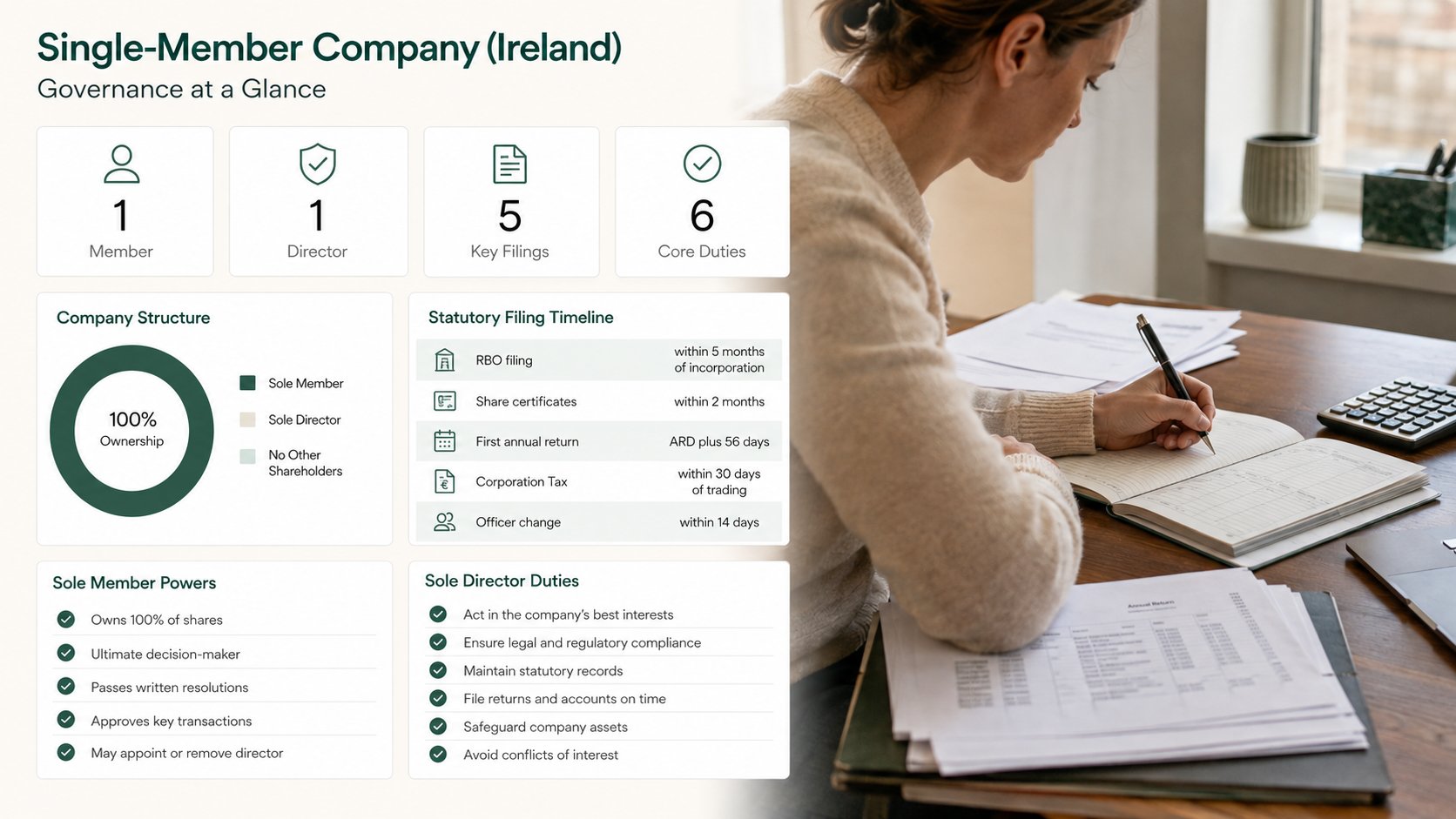
What does ownership mean in a single-member company?
Ownership gives the sole member shareholder powers. Those powers include voting on matters reserved to members, appointing or removing directors where the statutory procedure permits it and approving matters that require member approval. Ownership doesn't automatically give the member authority to perform every director or secretary function.
An Irish LTD has no minimum share capital, so the company doesn't need a prescribed minimum amount before it can be formed. That doesn't remove the need for accurate incorporation documents, lawful ownership records or beneficial ownership information.
What does being the sole director mean?
The sole director acts as the board for legal purposes, but remains subject to the statutory requirements that apply to directors. A director must be over 18, must not be disqualified and must not be a body corporate. Those eligibility limits apply even when the director owns every share.
For a founder outside Ireland the sequence matters more than the paperwork. Deciding who will hold the secretary's office before the company is formed is easier than appointing someone after the first annual return has already fallen due, which is the practical argument for settling the officer structure at Irish resident company formation rather than afterwards.
What can a sole member decide and what must a sole director still do in Ireland?
The cleanest way to understand the structure is to ask which legal hat the person is wearing. As sole member, the individual exercises shareholder powers. As sole director, the individual manages the company and carries the director's legal duties.
Section 196 of the Companies Act 2014 allows the sole member to exercise powers that would ordinarily be exercised by members. The sole member can act by written decision rather than arranging a physical general meeting. The Act also allows the sole member, in the circumstances provided by the legislation, to remove a director without holding a general meeting. That power belongs to the member because it concerns ownership and the composition of the board.
A written member decision should still be dated, clearly worded and retained with the company's statutory records. A written decision isn't an informal message or an undocumented instruction. It is the company's evidence of how the member exercised a reserved power.

What can the sole member do about general meetings?
A single-member company can dispense with physical general meetings, including AGMs, by using the written resolution route. A unanimous written resolution under section 175(3), read with section 193, can replace the meeting requirement where the statutory conditions are met.
That convenience doesn't eliminate reporting. The company must still prepare its financial statements and reports and send them to the member. The sole member can approve or deal with those matters without gathering people in a room, but the approval and records remain part of the company's legal administration.
What must the sole director do?
The sole director remains fully subject to the fiduciary duties codified in section 228. There is no reduced standard because the company has one member or one director. The director must act within the company's powers, act in good faith in the company's interests, exercise care, skill and diligence and deal properly with conflicts and interests.
The sole director must also maintain appropriate board records. Where there is only one director, the quorum rule in section 160(6) allows that sole director to perform the board function, but the decision still needs a proper record. A minute should identify the decision, the authority for it and any relevant interest or conflict.
Ownership and directorship can overlap, but they aren't interchangeable. The company is a separate legal person, so its obligations are its own. The director's exposure comes from the director's own conduct and from the duties in section 228, not from holding shares.
A person also cannot assume that one-director structures remove limits on other appointments. Section 142 caps the number of companies of which a person may be a director at 25 private companies limited by shares, or 25 companies in total where the group includes private companies limited by shares and other winding-up capable company types. Section 142 of the Companies Act 2014 sets out that directorship restriction.
What can one person do alone and what needs a second person in Ireland?
The following matrix separates the common actions that founders combine too readily. “Alone” means that the person can act in the relevant capacity without another shareholder or director. It doesn't mean that the company can ignore its secretary, records or filing rules.
| Action | Can one person do it alone | Why |
|---|---|---|
| Hold all the shares | Yes | A company can have a sole member for the time being under the Companies Act 2014. |
| Act as the only director | Yes | The Act recognises a company with one director and reads references to the board as references to that director. |
| Sign most CRO filings | Often, in the relevant capacity | The director may sign filings where the prescribed form requires a director's signature, subject to the form and the company's circumstances. |
| Pass a member written resolution | Yes | The sole member can exercise member powers by written decision under section 196. |
| Act as company secretary | No | Section 129(6) prevents the sole director from also being secretary. |
| Sign the annual return B1 alone | No | Section 343(4), read with section 134, requires the director and secretary signatures to come from different people. |
| Be counted twice for one act | No | Section 134 prevents one person from acting in both capacities where both are required. |
Why is the secretary a separate office?
The secretary isn't merely an administrative label. The office creates a separate statutory role within the company's governance structure. A separate individual or a corporate secretary must be appointed where the company has a sole director, and that appointment should be reflected accurately in the company's records.
A founder may put a company secretary service in place when establishing the company, provided the appointed structure and the service terms match what the company actually needs. The key point is that the secretary must be separate from the sole director for acts requiring both offices.
Which CRO documents are actually filed?
Board resolutions themselves aren't filed with the CRO. The company keeps those records internally. A consequential CRO form may be filed when a board decision changes registered information, and members' special resolutions may have filing requirements, but the underlying board minute isn't routinely sent to the CRO.
That distinction matters for a remote founder. The company should preserve signed member decisions, board minutes and executed documents in its statutory records, while filing only the forms and resolutions that the legislation requires. A neat internal record won't replace a missing signature on a prescribed filing.
How should a single member company record decisions and meet filing duties in Ireland?
A workable system starts by separating member decisions, board decisions and statutory filings. Each document should state who acted, in which capacity and under what authority. That simple discipline prevents a sole founder from treating every decision as a personal instruction.
The sole member can record a shareholder decision in writing under section 196. The document should identify the company, state the decision clearly and be signed by the member. It should then be retained with the company's records. The sole director should separately create a board record for matters falling within the director's management powers.
How can the company handle board decisions?
A sole director can make the board decision where the law and constitution permit it. The company should still record the date, decision, relevant background, authority and any director interest. The quorum is one where there is only one director under section 160(6), but quorum doesn't remove the need for minutes.
The record should be kept with the statutory books rather than confused with the CRO filing system. The CRO doesn't receive every board resolution. It receives the consequential form or resolution where a filing obligation applies.
Can the company dispense with its AGM?
A single-member company can usually avoid the physical AGM requirement through the unanimous written resolution mechanism described above. That doesn't mean the company can ignore the statutory timetable where an AGM is held or where a particular matter requires attention.
The first AGM falls within 18 months of incorporation, and no more than 15 months may pass between AGMs. Those timing rules should be tracked alongside the annual return date and financial statement obligations. A founder who chooses written resolutions should retain the resolution and supporting documents as evidence of the decision.
What must the company maintain beyond member and board records?
RBO information and Revenue registrations need to remain accurate when the company's ownership or control changes. VAT registration may also be relevant to the company's activities, but it isn't a substitute for corporation tax or CRO compliance. Formation with a compliant officer structure from day one can reduce the risk that the first annual return reaches the company before the secretary and signature arrangements are ready.
A remote founder should nominate a secure place for statutory records and establish who monitors CRO correspondence, Revenue notices and RBO updates. The process should work even when the founder is outside Ireland.
What happens if a single member company gets governance wrong in Ireland?
The signature problem can create consequences beyond a rejected form. If the company can't produce a valid annual return, the filing becomes late even where the director completed the commercial information correctly. The delay can affect the company's compliance position and may create avoidable professional work.
Section 363, as amended from 16 July 2025 by section 22 of the Companies (Corporate Governance, Enforcement and Regulatory Provisions) Act 2024, commenced by S.I. No. 325 of 2025, applies a two-strike test. The audit exemption is lost for the following two financial years where the annual return is filed late and the company also filed late at some point in the five years immediately preceding that financial year. A late first annual return after incorporation is disregarded, and so is any late filing that occurred before 16 July 2025. Late filing fees apply in any event. Separately, failure to make an annual return under section 343 is the first ground for involuntary strike off under section 726. The CRO's company registration information is the appropriate official starting point for maintaining the company's filing obligations.

What does section 137 mean for a non-EEA founder?
A company with no EEA-resident director must either appoint an EEA-resident director, including a nominee where appropriate, or hold a section 137 bond. The bond is the insurance instrument. It isn't a separate alternative to the requirement, and the EUR 25,000 sum guaranteed to the State is the guarantee amount, not a service price.
A nominee arrangement doesn't transfer the founder's responsibilities away. The director in office remains subject to section 228 duties, and the company must maintain accurate records of its officers and beneficial ownership.
Does a single member structure change the company's tax position?
No. The company is a separate taxpayer however its shares are held, and its treatment turns on the nature of its income and its activities rather than on the number of members. Rates, thresholds and reliefs change, so check the current position on the Revenue website instead of relying on a figure quoted in an article.
Governance and tax are connected operationally, but they remain separate legal questions. A compliant secretary won't convert passive income into trading income, and a sole director's filing failure won't be cured by a tax registration.
How can a non-EEA founder set up a compliant single member company in Ireland?
A remote founder can reduce execution risk by checking the structure before the company starts trading:
- Separate the offices: Appoint a secretary who is a different person from the sole director.
- Plan the B1: Confirm that the annual return will be signed by the director and secretary in their separate capacities.
- Record member decisions: Use written member decisions under section 196 and retain them with the statutory books.
- Keep board minutes: Record sole-director decisions even though the sole director performs the board role.
- Choose the meeting route: Use a unanimous written resolution where the company lawfully dispenses with an AGM.
- Address residence: If no director is EEA-resident, arrange an EEA-resident director or the section 137 bond.
- Maintain registers: Keep RBO information and Revenue registrations accurate and up to date.
The practical objective is not to add unnecessary formality. It is to ensure that the person who owns the company can exercise ownership powers while the company still has the separate officer needed for execution and administration.
Founders can review Irish resident company formation to arrange an officer structure that reflects these requirements from the first day the company exists.
Who can be my company secretary in a single-member Irish company?
The secretary must be a separate office-holder from the sole director. The role may be held by another suitable individual or by a corporate secretary, subject to the Companies Act 2014 and the company's records. The sole director cannot appoint himself or herself to both offices.
Can my spouse sign the annual return?
A spouse may sign as secretary only if that spouse has properly been appointed to the secretary's office and signs in that capacity. The signature isn't valid merely because the person is related to the director or helped prepare the form. The director and secretary must remain different persons for an act requiring both signatures.
Does a single-member company need an AGM?
A single-member company can dispense with a physical AGM by using the applicable unanimous written resolution process. The company still needs to deal with financial statements, reports, approvals and records, and it must observe the statutory AGM timetable where an AGM is held or required.
What happens if the only director is abroad?
The company continues to have a sole director if that person remains properly appointed and eligible. Being abroad doesn't remove the need for a separate secretary, valid signatures, board records, CRO filings, RBO information or Revenue compliance. The company should arrange reliable document execution and correspondence monitoring before deadlines arise.
Does a sole director face lighter duties?
No. Section 228 duties apply to a sole director in full. A one-person ownership structure may simplify decision-making, but it doesn't reduce the standard of care, the duty to act in the company's interests or the obligation to maintain proper compliance records.
Chern & Co (RegisterCompany.ie) offers Irish LTD formation with attention to the separate director and secretary structure required by Irish company law. Visit Chern & Co (RegisterCompany.ie) to arrange formation support for a compliant single-member company, including the practical requirements relevant to remote non-EEA founders.
Setting up that single-member company from outside the EEA? See our non-resident company formation package for remote founders.
This content is general guidance, not legal or tax advice.


