

Last updated: 09 September 2026
A founder usually reaches this point with the company incorporated, the offer agreed, and a first pay date already mentioned to the new hire. That is exactly when payroll mistakes start. In Ireland, the first salary can't be treated as an admin task to tidy up afterwards.
The short answer is simple. The company must register as an employer with Revenue before paying its first employee, obtain the employee's Revenue Payroll Notification, and have payroll set up to submit to Revenue on or before the pay date. Revenue's employer guidance is clear that employer registration should be completed before the first wage or salary payment is made through ROS and MyEnquiries, and Irish payroll reporting then runs on a real-time basis for each pay event, as Revenue explains in its employer registration guidance.
The employer registration itself is rarely the slowest part. The delays are nearly always ROS access, employee PPS details, and late retrieval of the RPN. Founders who fix the first pay date first, and the payroll setup second, are the ones who create emergency tax, failed submissions, and avoidable corrections.
What an Irish Company Must Do Before It Pays Its First Employee?
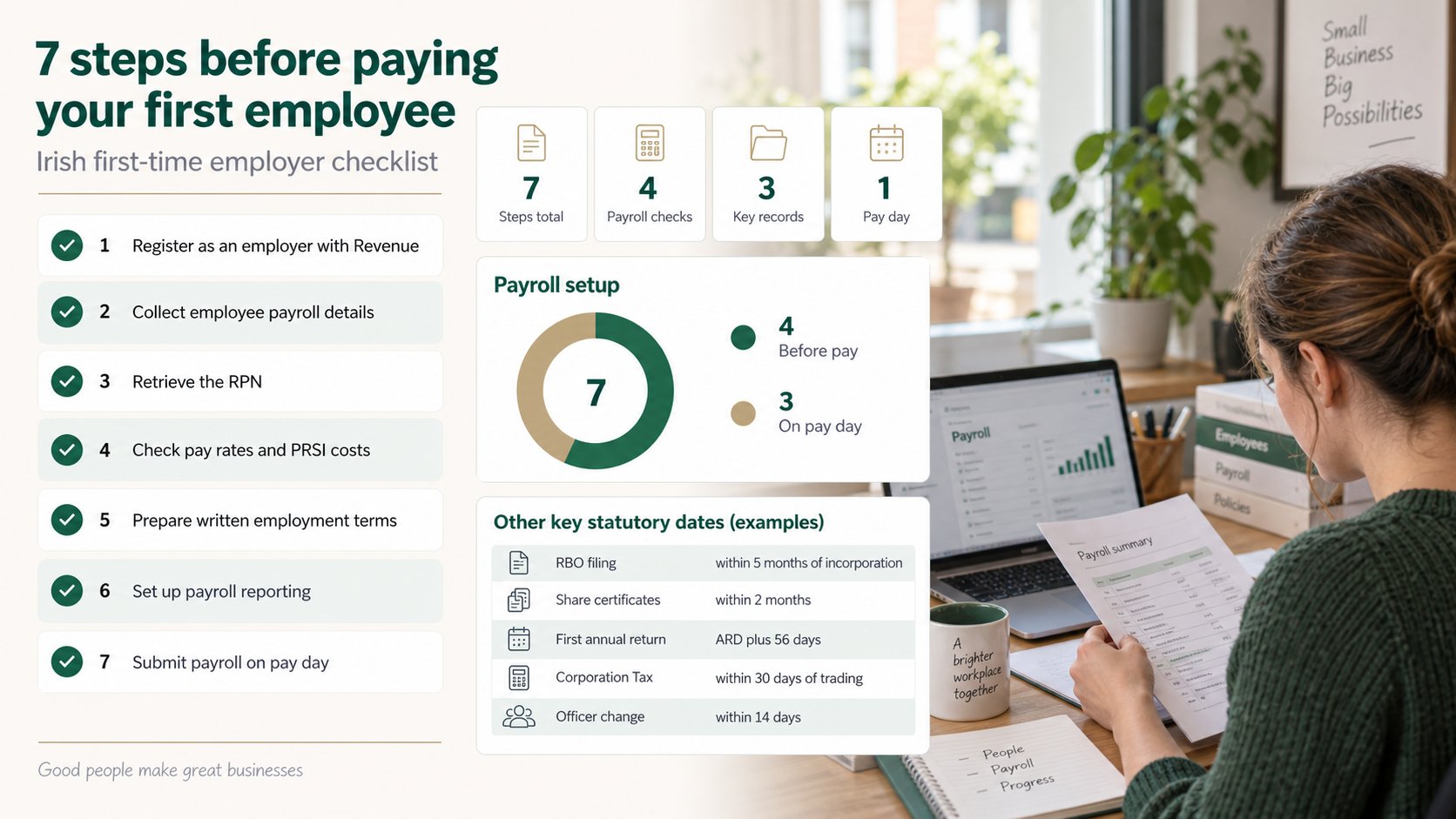
The sequence matters more than most founders expect. For a first-time employer, the right order is usually this:
- Register the company as an employer with Revenue
- Collect the employee data needed for payroll
- Retrieve the RPN before the first pay run
- Check the pay rate and statutory payroll costs
- Put the written employment terms and policies in place
- Prepare payroll for real-time and enhanced reporting
- Submit the first payroll to Revenue on or before pay day
This catches three groups in particular. The first is the non-EEA founder who formed an Irish LTD remotely and assumes payroll can wait until trading begins. The second is the foreign-resident director who wants to start taking salary. The third is the start-up hiring its first local employee and discovering that Irish payroll doesn't permit a casual first payment with the paperwork added later.
Practical rule: the first pay date should be the last variable fixed, not the first.
That approach works because Irish payroll is event-based. Revenue expects the employer record, employee setup, and payroll data to be in place before money moves. Waiting until wages are due doesn't save time, it compresses the only part of the process that must be accurate on day one.
How Does an Irish LTD Register as an Employer With Revenue?
A company can be incorporated, registered for other taxes, and still be unable to pay its first employee correctly. Employer registration is a separate Revenue step, and it must be completed before the company makes its first wage or salary payment.
What must be ready before registration?
The company needs its CRO registration completed, access to Revenue's online services, and a planned payroll start date. Incorporation can take about 10 to 15 working days, so payroll planning should begin before the intended payday. The company must exist in Revenue's records before the employer setup can be completed.

Revenue requires the business to provide its name, address, and intention to pay staff through ROS and MyEnquiries. The notification must be made before the first payment. There is no separate statutory lead time stated for the filing, so the practical deadline is the first wage or salary payment.
A remote formation process often deals with incorporation before anyone examines payroll readiness. That is why a non-EEA founder forming an Irish company remotely should confirm the employer setup as soon as the company is formed, particularly if a director or employee will be paid soon.
What causes delays?
Employer registration does not happen automatically when the company becomes active for tax. The employer record requires its own notification. Filing late can leave too little time to complete the payroll setup and obtain the information needed for the planned pay date.
Prepare the MyEnquiries submission in plain English before filing it. The description should make clear that the company intends to employ staff and state the expected first payment date. This avoids avoidable questions where the founder is handling payroll internally or coordinating with an accountant.
Where the registration needs to be handled separately, employer tax registration with Revenue can be treated as a distinct task rather than assumed to form part of general company tax registration.
File early enough to resolve queries before payday. A late employer registration can disrupt the first payroll, even where the company and employee records are otherwise ready.
What Does the Company Need From the Employee Before the First Pay Run?
Before the first payroll is prepared, the employee record must be complete. Collect the employee's PPS number, confirmed start date, and the RPN for that employment. These details connect the person, the job, and the intended pay date to the payroll submission.
Why does the PPS number matter so early?
The PPS number identifies the correct employee in the payroll record and helps the submitted details match Revenue's records. The start date must also be accurate. It affects the period being reported, the tax basis used, and whether the first payment is treated as the employee's initial pay from this employer.

For a non-EEA hire, check the right-to-work documents separately. The work authorisation is the employment permit under the Employment Permits Act 2024. The immigration document is the Irish Residence Permit. They serve different purposes, and an Irish Residence Permit alone does not authorise a person to take a particular job.
A founder-director may also have addressed the company's residency requirements through an EEA-resident nominee director, or through the section 137 bond under the Companies Act 2014. That company-level arrangement does not establish an employee's permission to work. Check that the role, employer, and permit held match on the actual start date.
What happens if the company pays before getting the RPN?
Paying before retrieving the RPN produces an incorrect first payslip. Revenue's guidance on taking on an employee explains the need to register the employment where required and obtain the notification so Income Tax, USC, and PRSI can be calculated correctly, as set out on Revenue's employer setup page.
Without the RPN, the employee is placed on the emergency tax basis. A later payroll submission can correct the position, but the employee may see excessive deductions in the meantime. That creates an avoidable issue on the first payday.
Keep the sequence fixed: confirm the employee data, retrieve the RPN, calculate the pay, and submit the payroll information to Revenue on or before the pay date. If the RPN is unavailable, stop and resolve the setup rather than treating an early payment as a harmless shortcut.
What Are the Current Rates and Thresholds That Apply to the First Payslip?
A first payday can expose a funding gap immediately. The company must cover gross wages, employee deductions, employer PRSI, statutory payments, and any pension-related contribution that applies. Use the figures below as a live check for the pay period, not as values copied from an old spreadsheet.
Which figures matter on payday morning?
PRSI sits within the same payroll framework as PAYE and USC. Employer PRSI is a separate company cost once the employee is paid, as Revenue's PRSI guidance confirms. The applicable rate depends on the pay date, so the payroll record must distinguish rates applying up to 30 September 2026 from rates scheduled for later in 2026.
| Item | 2026 Rate / Threshold | Employer vs Employee |
|---|---|---|
| Class A PRSI, until 30 September 2026, weekly earnings up to EUR 552 | Employer 9.00 per cent | Employer cost |
| Class A PRSI, until 30 September 2026, weekly earnings above EUR 552 | Employer 11.25 per cent | Employer cost |
| Class A PRSI, until 30 September 2026 | Employee 4.20 per cent | Deduct from employee pay |
| Class A PRSI, from 1 October 2026, weekly earnings up to EUR 552 | Employer 9.15 per cent | Employer cost |
| Class A PRSI, from 1 October 2026, weekly earnings above EUR 552 | Employer 11.40 per cent | Employer cost |
| Class A PRSI, from 1 October 2026 | Employee 4.35 per cent | Deduct from employee pay |
| National minimum wage, age 20 and over, from 1 January 2026 | EUR 14.15 per hour | Minimum gross pay floor, see the Workplace Relations Commission minimum wage guidance |
| National minimum wage, age 19 | EUR 12.74 per hour | Minimum gross pay floor, see the Workplace Relations Commission minimum wage guidance |
| National minimum wage, age 18 | EUR 11.32 per hour | Minimum gross pay floor, see the Workplace Relations Commission minimum wage guidance |
| National minimum wage, under 18 | EUR 9.91 per hour | Minimum gross pay floor, see the Workplace Relations Commission minimum wage guidance |
| Statutory sick leave | Five paid days a year, 70 per cent of usual daily earnings, capped at EUR 110 a day, certified leave only, after 13 weeks of continuous service, under the Workplace Relations Commission sick leave guidance | Employer payment where eligible |
| My Future Fund, years 1 to 3 | Employee 1.5 per cent, employer 1.5 per cent, State top-up 0.5 per cent, as set out in the official My Future Fund contribution information | Split between employee, employer, and State |
| My Future Fund eligibility | Ages 23 to 60, earning EUR 20,000 or more a year across all employments, and not already in a pension, subject to the official eligibility information | Eligibility determined outside employer discretion |
What should the founder do with these numbers?
Apply the table in order on payday morning. First test the agreed hourly rate against the employee's age-based minimum wage. Then calculate gross pay and employee deductions, and add employer PRSI to the company's cash requirement. Use the rate applying on the actual pay date, treating the October PRSI figures as scheduled rather than current until the legal change takes effect.
The sick leave figure also affects the payroll process and written workplace rules. My Future Fund eligibility should be checked against the employee's age, combined earnings, and existing pension position. A founder who budgets only for the employee's gross salary can understate the cost of the first hire.
What Written Terms and Statutory Policies Must Be in Place Before Day One?
Payroll readiness is not only a Revenue exercise. Before the first payslip, the company also needs the employment documentation and workplace basics in order.
What has to be given to the employee at the start?
Under the Terms of Employment (Information) Act 1994, as amended, including the Employment (Miscellaneous Provisions) Act 2018 and S.I. No. 686 of 2022, the core terms must be in writing within five days of commencement, and the full written statement must be provided within one month.
The day-five core terms include:
- Names: the full names of employer and employee
- Address: the employer address or principal place of business in the State
- Work location: the place of work, or a statement that the employee works at various places
- Role: the job title, grade, nature or brief description
- Start date: the commencement date
- Probation: the terms of any probationary period
- Duration: the expected duration where the contract is temporary or fixed term
- Pay details: remuneration, the frequency and the method of payment
- Hours: the expected hours per day and per week
- Overtime terms: the terms about hours of work including overtime
- Tips policy: the employer policy on tips, gratuities and mandatory charges where relevant
Which other legal documents are usually forgotten?
The Organisation of Working Time Act 1997 governs annual leave, public holidays, and the duty to keep working time records. The Safety, Health and Welfare at Work Act 2005 requires a written safety statement based on a risk assessment.
Employer liability cover is commonly arranged at the same time, but it should be described accurately. It is standard practice and often required by a lease or client contract, not a statutory rule in itself. Employers liability cover is a commercial insurance decision that sits outside payroll law, so it belongs with a broker rather than in the Revenue or CRO sequence.
A signed contract doesn't cure a missing five-day statement, and a payroll file doesn't replace working time records.
For non-EEA hires, the company should check the employment permit before the offer becomes operational. Checking after the employee turns up for work is late. An Irish Residence Permit is an immigration permission, not a work authorisation, so relying on it in place of an employment permit is the common error here.
How Does Real-Time Reporting and Enhanced Reporting Work From the First Pay Date?
The first payroll submission is the point at which planning stops and compliance starts. In Ireland, employers must report payroll details to Revenue on or before each pay date, not later and not as a monthly catch-up exercise.
What does the company have to send on pay day?
The payroll submission must reach Revenue on or before the payment date, every pay period. A company that pays wages on Friday and files on Monday is late. That pattern is more common than founders think because some assume there is a grace period. There isn't.
Enhanced Reporting Requirements have applied since 1 January 2024 under section 897C of the Taxes Consolidation Act 1997, inserted by the Finance Act 2022. Three categories are reportable on or before the payment date:
- Small benefit exemption items
- Remote working daily allowance
- Travel and subsistence
Why does enhanced reporting catch first-time employers so often?
Because it isn't limited to salary. The first reimbursed flight, hotel bill, or remote working allowance can trigger reporting on day one if it falls within the reportable categories. Founders often focus on salary calculations and miss the first expense reimbursement entirely.
The first late filing often isn't the payroll itself. It's the expense paid outside payroll and reported too late.
This article stops at the first submission, but the same timing discipline applies afterwards. Where the founder wants that ongoing process handled after the initial setup, payroll services Ireland is the relevant ongoing payroll route.
What Is the Pre-Pay Date Checklist for an Irish Company Hiring Its First Employee?
A workable checklist should run backwards from the intended pay date. That is more reliable than trying to improvise once the employee has already started.
What should be done in the weeks before the first pay date?
- T minus 4 weeks: confirm the company is incorporated through the CRO, confirm Revenue access is workable, and avoid promising a fixed first pay date until those basics are live.
- T minus 3 weeks: submit the employer registration through MyEnquiries, collect the employee PPS number, and for a non-EEA hire confirm the employment permit covers the role offered.
- T minus 2 weeks: issue the written terms covering the day-five core items and prepare the fuller statement due within one month, agree pay frequency and payment method, and make sure cleared funds will be available.
- T minus 1 week: configure payroll, retrieve the employee's RPN, test the deductions against current PRSI and pension settings, and verify that working time records and the safety statement are in place where required.
- Pay day: issue the payslip, release the payment, and make the payroll submission to Revenue on the same day. If a reportable expense or allowance is being reimbursed, include the enhanced reporting step on or before that date as well.

A simple operational rule helps here. Keep the first pay run boring. No backdating, no guessed tax settings, no manual workaround for a missing PPS number, and no assumption that Revenue will accept a Monday filing for a Friday payment.
A generic onboarding checklist can be useful as a process prompt, but Irish payroll timing has to be applied by reference to Irish Revenue rules, not to a checklist written for another jurisdiction.
What are the most common first-payroll mistakes?
- Late RPN retrieval: this leads to emergency basis tax and a wrong first payslip.
- Late enhanced reporting: the first reimbursed expense gets missed because it isn't thought of as payroll.
- Treating incorporation as payroll readiness: the company exists, but the employer tax registration with Revenue and the employee setup are still incomplete.
- Fixing the salary date too early: the organisation then tries to force payroll around a date that should have been confirmed last.
Can a company make a very small first payment without full payroll setup?
No safe shortcut should be assumed. Revenue's guidance says that if you hire an employee you must register as an employer, and that you should do this through MyEnquiries in ROS before paying your employee. Payroll reporting then applies on or before the payment date. The only threshold exemption Revenue publishes does not apply here: it covers a single domestic employee paid less than EUR 40 per week. A company must also register as an employer and operate PAYE on a director's income even where there are no other employees.
Does paying a director's first salary trigger the same employer obligations?
Yes, if the director is being paid as salary. The issue isn't whether the worker is a founder, it is whether the company is making employment-type payments that belong in payroll. Director salary is not outside the PAYE framework.
Is the Register of Beneficial Ownership part of first-payroll setup?
No. The RBO records beneficial ownership under separate rules and has nothing to do with hiring or paying an employee. Founders often bundle CRO, RBO, and Revenue tasks together mentally, but payroll readiness turns on employer registration, employee data, and reporting capability.
Who decides whether My Future Fund applies to the employee?
The employer doesn't decide eligibility. NAERSA identifies eligible employees from Revenue payroll data and notifies the employer by an Automatic Enrolment Payroll Notification through payroll software. The employer's job is to register on the employer portal, set up a payment method, make sure payroll can process contributions, and pay them when wages are paid.
Chern & Co can handle the employer registration step, align it with the company's Irish setup, and help founders avoid the usual first-payslip failures around PPS data, RPN timing, and Revenue submission readiness. For a practical starting point on Irish company and payroll setup, visit Chern & Co (RegisterCompany.ie).
Does the first employee or a director still need a PPS number? Our PPS number application handles it.
This article is general guidance, not legal or tax advice.


