

American migration to Ireland has changed direction. In the 12 months leading to April 2025, 9,600 US citizens migrated to Ireland, up 96% from 4,900 in the previous year, the highest level recorded since the CSO began compiling the figures, according to RTÉ reporting on CSO population data. That shift matters because the practical reality for Americans living in Ireland is not just about visas or housing. It is about residency status, dual tax filing, Irish company law, and the extra banking friction that US persons often face.
For US founders and professionals, the move works well when it is planned as a compliance exercise from day one. The common failures are predictable. People assume Irish immigration status and Irish tax residence are the same thing, they discover the section 137 director rule too late, or they try to open bank accounts before their CRO and RBO records are in order. Ireland is manageable. It just rewards preparation and punishes assumptions.
Your Guide to Moving to Ireland from the US
The recent movement of Americans into Ireland is large enough to change how advisers should approach the topic. This is no longer a niche relocation question. It is a mainstream planning issue for employees, families, and non-EEA founders who want an Irish base or an Irish LTD.

The reason generic expat advice often fails Americans is simple. US citizens don’t just move country, they carry a continuing US tax filing obligation with them. If they also plan to trade through an Irish company, they enter a legal system shaped by the Companies Act 2014, CRO filing rules, Revenue Commissioners registrations, and beneficial ownership reporting. That is a very different exercise from renting a flat and changing mobile provider.
Americans living in Ireland usually need three plans, not one: an immigration plan, a tax plan, and if they will trade, a company law plan.
For founders, the practical sequence matters. The right order is usually status first, then tax mapping, then company structure, then banking. When the order is reversed, the friction shows up quickly. A founder tries to incorporate without dealing with the EEA-resident director issue, or applies for banking before the corporate record is complete, or starts trading before deciding how remuneration will work.
Ireland remains attractive because the legal system is familiar enough for common law users and the corporate framework is clear. What doesn’t work is assuming that Irish administration resembles US state-level incorporation. It doesn’t. Identity verification is stricter, director residency rules are more specific, and Revenue and CRO filings need to line up from the outset.
Residency and Visa Options for US Citizens
According to the 2022 Census, 13,412 US citizens were living in the Republic of Ireland, up 27.5% from 2016, and 26.4% were based in the Greater Dublin Area, as reported by The Irish Star covering the Census data. That concentration makes sense. Dublin and the surrounding area remain the most common landing point for work, family relocation and business setup.

Where many Americans start
For US citizens moving for work, the practical question is not solely whether Ireland is welcoming. It is which permission lets them live and work lawfully in the State, and what that permission allows a spouse, partner or children to do.
The routes most often considered in practice are employment-based permission and family-based permission. Employment routes usually matter most for professionals and founders who aren’t relying on Irish or EU citizenship through family. In everyday advisory work, the distinction that matters is whether the person has a permission tied tightly to an employer, or a broader permission that gives more freedom in the labour market.
A common source of confusion is the Irish Stamp system. Americans often focus on the entry permission and overlook the residence permission attached to it. That is a mistake because the stamp dictates what the person can do in Ireland, especially whether they can work without needing a separate employment permission.
What status actually changes in practice
From a practical perspective, Stamp 4 is usually the status people want to reach because it gives broader permission to live and work without the same level of employer dependence. Before that point, the person needs to read the conditions of their current status carefully. The permitted activity matters for employment, self-employment and directorship.
Three working rules help avoid trouble:
- Match the activity to the permission: Holding a company directorship, being self-employed, and working under an employment contract aren’t interchangeable in Irish immigration practice.
- Keep the immigration file consistent: Passport details, Irish address records, and supporting documents should match across applications, bank files and Revenue registrations.
- Don’t assume property ownership solves status: Buying or renovating property may support a relocation plan in a practical sense, but it does not itself create a residence right.
A visa label, an Irish Residence Permit, and tax residence are separate concepts. Americans living in Ireland often run into problems when they treat them as the same thing.
For families, the issue is usually dependency and sponsorship evidence. For founders, it is often harder. A person may be able to incorporate an Irish company, but that does not mean the incorporation alone creates a right to live in Ireland. Corporate structure and personal immigration status must be analysed separately.
Official checks on company filings should always go to the Companies Registration Office, and Irish tax registration and residency guidance should be checked with the Revenue Commissioners. For beneficial ownership filings after incorporation, the relevant register is the Register of Beneficial Ownership.
Navigating US and Irish Tax Obligations
For Americans living in Ireland, tax usually becomes the decisive compliance issue after immigration. The core problem is that the United States taxes by citizenship, while Ireland taxes by residence. That means one person can be drawn into two systems at once.

The day-count rule is where the Irish side starts
Irish tax rules for US expats
US citizens become Irish tax resident after 183 days in a tax year, and they can also trigger residence over 280 days across two consecutive years, while still having to continue annual US filing because of citizenship-based taxation. For planning purposes, this means the calendar matters more than intention.
That point is often missed by founders who say they are only “trying out” Ireland. Revenue does not analyse intention first. It starts with presence, connection and the applicable rules. A person can become Irish tax resident faster than expected if the move is not tracked carefully.
A basic record should include:
- Arrival and departure dates: Keep a clean travel log by calendar day.
- Income source mapping: Separate US salary, Irish salary, dividends, consulting income and company receipts before the first return is due.
- Document trail: Retain Revenue correspondence, employment records, and company resolutions in one file.
What the treaty does, and what it does not do
TINs and VAT IDs
The US-Ireland Double Tax Agreement is the mechanism used to reduce double taxation risk, including residence tie-breaker analysis under Article 4. It helps determine which state has treaty residence priority in certain cases. It does not remove the need to file where filing obligations still exist.
For non-EEA founders, company structure can also affect tax administration. An EEA-resident nominee director to satisfy section 137 of the Companies Act 2014 for Irish companies without an EEA-resident director may be one operational solution, such as the Nominee / Resident Director Service (Section 137 compliance), but that company law solution does not replace personal tax planning.
Practical rule: map the move by days, decide where management decisions will be taken, and document how the founder will be paid before the company starts trading.
A common error is informal mixing. Personal US income streams, Irish company income and director payments should never be blurred together. That creates avoidable difficulty for bookkeeping, Revenue registration and US reporting.
Setting Up Your Life: Practicalities and Costs
Once status and tax are mapped properly, the practical side of life in Ireland becomes easier to manage. The friction points for Americans are usually housing, address evidence, and banking. Those three issues affect almost every other step because they feed into registrations, insurance, school forms and account opening.
Housing, banking and proof of address
Proof of address is more important in Ireland than many US clients expect. It is needed repeatedly, not just once. Banks ask for it, Revenue queries may depend on it, and any inconsistency between a lease, utility bill and company records can slow down follow-up administration.
US citizens also see additional banking checks because of US tax reporting rules. In practice, that means banks may look more closely at identity documents, ownership structure and tax status. The issue is not that Americans can’t open accounts. It is that the file has to be cleaner on the first submission.
A workable order is usually:
- Secure the address basis first: a lease, host declaration, or other acceptable proof should be settled before multiple applications begin.
- Open the right account type: personal banking and business banking should be treated as separate projects.
- Keep records consistent: names, spellings, dates of birth and addresses should match exactly across all forms.
Healthcare, schools and routine administration
Healthcare and schools are less legally complex than tax or company formation, but they still require routine administration. A family moving with children should start school enquiries early because catchment, admissions policy and document requests vary by school. Healthcare registration also works better when proof of address and identification are already in order.
For day-to-day life, the point isn’t to overcomplicate the move. It is to understand that Irish administration depends heavily on documentary sequence. If one piece is missing, several others tend to stall.
Vacant Property Refurbishment Grant and non-resident eligibility
Property is another area where Americans often draw the wrong conclusion. The Vacant Property Refurbishment Grant of up to EUR 50,000 exists for qualifying refurbishments, but eligibility conditions apply and ownership or grants create no residence rights. The legal right to live in Ireland still has to come from the correct immigration basis.
A simple comparison helps:
| Issue | What works | What does not work |
|---|---|---|
| Address evidence | One stable Irish address used consistently | Different addresses across bank, tax and immigration files |
| Banking | Complete identity and corporate file before application | Applying with missing proofs and expecting the bank to fill gaps |
| Property purchase | Treating property as an asset decision | Assuming ownership creates residence rights |
| Family administration | Preparing school and medical records early | Waiting until arrival to collect basic documents |
Buying a property may support a long-term plan. It doesn’t replace visa or residence permission.
Americans living in Ireland usually do best when everyday administration is treated with the same discipline as tax and company filings.
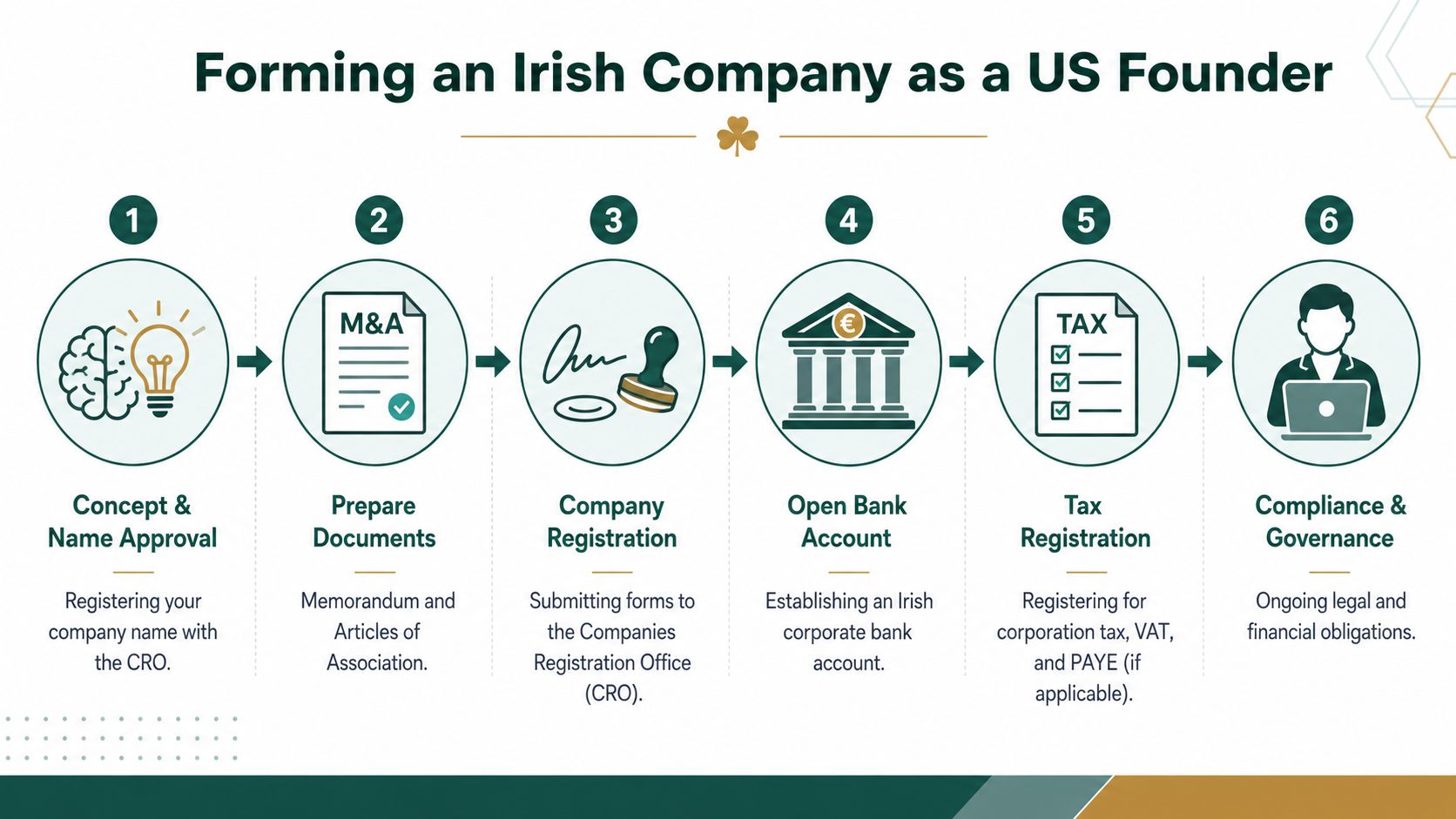
Forming an Irish Company as a US Founder
For a US founder, the biggest legal difference between Ireland and the United States is usually discovered too late. Irish private companies are subject to the Companies Act 2014, and the director residency rules are often the first serious obstacle in a remote formation.
The section 137 issue is the main legal obstacle
Irish company director residency requirements and CRO timing
Under section 137(2) of the Companies Act 2014, a private limited company with all directors resident outside the EEA must secure a EUR 25,000 surety bond, valid for two years, from an authorised Irish provider if it wants to incorporate without an EEA-resident director, as set out in this explanation of the section 137 bond requirement.
That is not a minor filing detail. It affects whether the company can be incorporated at all in its proposed form. A related procedural point matters as much as the legislation itself. The bond must be effective from the incorporation date and the number must be furnished to the CRO before the CRO processes the incorporation.
For founders who want to remain the sole operational decision-maker, there are normally two professional routes. One is an EEA-resident director appointment. The other is the section 137 bond.
A practical comparison of the two routes
| Route | Best fit | Main advantage | Main trade-off |
|---|---|---|---|
| Nominee EEA-resident director | Founder wants a straightforward filing path | Satisfies the residency rule through an appointment | Ongoing governance must be documented properly |
| Section 137 bond | Founder wants to remain the only director | No need to appoint an EEA-resident director | Bond must be arranged before incorporation and monitored carefully |
Current professional fees are fixed: EUR 3,000 applies to non-resident formation, EUR 2,000 to EEA resident formation, EUR 5,000 to a ready-made company, EUR 12,000 to a ready-made company with VAT, and EUR 2,000 per year to a nominee director arrangement.
start amazon fba with ai
A factual example of an end-to-end route is Non-Resident Company Formation (All-inclusive for Non-EEA Residents), which covers CRO registration with statutory documents, nominee EEA-resident director, company secretary and registered office for 12 months, RBO filing, Corporation Tax, PPS and Income Tax registrations, IPN number and the first annual return. Chern & Co Ltd is an authorised Irish TCSP, reference APP/1211/2018.
Founders who prefer not to appoint an EEA-resident director can instead use the Non-EEA Resident Director Bond route, provided the bond is in place before incorporation.
US e-commerce founders often ask whether Ireland can be used as a base for wider EU trading. It can, but that question should be analysed after the legal formation mechanics are settled.
Managing Your Irish Company’s Finances
Once the LTD exists, the founder’s next risk is not incorporation. It is informal management. Here, many otherwise careful US clients create tax and accounting problems for themselves.
Board control, payment structure and records
Three disciplines matter more than anything else.
First, the company should document where key management decisions are made. Board minutes, written resolutions and director records are not just housekeeping. They help support the company’s governance and tax position.
Second, the founder should decide how money will move from the company before trading starts. Salary, director remuneration and dividends are not interchangeable labels. Each route has different accounting and tax consequences, and those consequences should be analysed before the first invoice is raised.
moving to Ireland from the US and founder administration gaps
Third, the Irish accountant and the US tax adviser should be coordinated early. US ownership of a non-US company can create complex US reporting consequences, so the timing of drawings and retained profits should not be improvised.
Where founders create problems for themselves
The main operational gap in generic expat advice is that it often ignores the timeline and hidden administrative burden for non-EEA founders who need a compliant corporate structure before banking and tax services can function properly. For a broader relocation overview, see our guide on moving to Ireland from the US.
In practice, the weak points are predictable:
- Unclear management location: the founder runs everything informally from different places and keeps no board record.
- Mixed funds: personal expenses and company money are treated as one pool.
- Late adviser involvement: the US and Irish positions are reviewed only after income has already been drawn.
Keep the company separate from the founder in both documents and money flow. That single discipline prevents a large share of later problems.
A clean CRO record, up-to-date RBO filing and orderly Revenue registrations also make banking easier. Banks rarely reward incomplete files.
Essential Document and Action Checklist
A move works best when the paperwork is assembled by purpose, not in one large pile. Americans living in Ireland usually need two separate files, one for the personal move and one for the Irish company.

Personal move and residency file
- Passport and status documents: valid passport, visa permission documents where applicable, and residence records.
- Civil documents: birth certificate, marriage certificate if relevant, and family relationship documents for dependant applications.
- Address evidence: lease, utility record, or equivalent proof accepted for Irish administration.
- Health and school records: policy documents, vaccination records, and school papers for children.
- Tax travel log: a simple day-count record to support Irish residence analysis.
Irish company formation file
- Identity file for directors and owners: notarised passport copy and certified proof of address where required.
- Company structure documents: company name choice, activity description, shareholder details and director details.
- Section 137 solution: either the EEA-resident director arrangement or the bond route, prepared before filing.
- CRO and RBO readiness: beneficial ownership details, registered office information and company secretary details.
- Revenue registrations: corporation tax, and any personal tax registrations that must align with the company file.
A missing identity document can delay incorporation. A mismatched address can delay banking. A missing director residency solution can stop the formation entirely.
Frequently Asked Questions for US Expats
Can a US citizen form an Irish LTD without travelling to Ireland
Yes, remote formation is possible if the identity documents are prepared correctly and the director residency issue is solved at the outset. The practical friction is usually not travel. It is getting the notarised and certified document set right the first time, and making sure the CRO filing data matches the Revenue and banking file.
What is the biggest obstacle for US founders
The most common obstacle is the EEA-resident director requirement under section 137 of the Companies Act 2014. Many American founders only discover it after they have chosen the company name and planned the launch. The second common problem is identity and number administration, particularly where the founder needs an IPN for filing and the document trail has not been prepared properly.
How long does it take to open an Irish business bank account
There isn’t one universal timeline. Fintech and EMI business accounts often open within days to two weeks, and that is where many non-resident-owned companies begin. Traditional Irish banks can take several weeks to a couple of months for non-resident-owned companies. The usual sticking points are proof of address and whether the corporate file is complete.
Does buying property in Ireland make residency easier
Not by itself. Property ownership and immigration status are different legal questions. A person may buy or renovate property, but that does not create an automatic right to live in the Republic of Ireland. Residence permission still has to be qualified for separately.
What tax mistake do Americans make most often after the move
They assume residence, tax and company management can be dealt with later. In practice, the right approach is to track physical presence by day, decide where management decisions will be made, and agree how the founder will be paid before trading starts. Filing problems usually begin when those points are left informal.
For US founders who need a remote Irish LTD setup with the section 137 issue handled correctly from the start, Chern & Co (RegisterCompany.ie) provides Irish company formation support as an authorised TCSP for non-EEA and EEA clients.
This content is general guidance, not legal or tax advice.


